Who Is Bhairav (Bhairava) in Tantra?
The text at the heart of this tradition is called the Vigyan Bhairav Tantra. Bhairava is literally in the name. And yet, for many people approaching this text for the first time, Bhairava remains a vague or slightly unsettling figure — associated with dark iconography, fierceness, perhaps something to be feared or appeased.
This misunderstanding is worth correcting, because it shapes how the entire text is received. Understanding who Bhairava is — really is, in the terms of Kashmir Shaivism — changes the way you relate to the 112 techniques the text contains.
For broader context on the text itself, see the introduction to the Vigyan Bhairav Tantra.
The Etymology of Bhairava
In Sanskrit, etymology is considered a key to meaning. The word “Bhairava” is derived from the root bhī — fear or awe, the feeling of confronting something vast beyond ordinary comprehension. The suffix ra carries the sense of dissolution. Bhairava, in this reading, is “one who dissolves fear” — or more precisely, what lies on the other side of fear when it is fully faced: shattering clarity rather than cozy reassurance.
Some scholars also read the three syllables bha, ra, va as encoding three cosmic functions — maintenance, dissolution, and grace. In this reading, Bhairava is not one aspect of reality but its totality.
The Iconography — and What It Points To
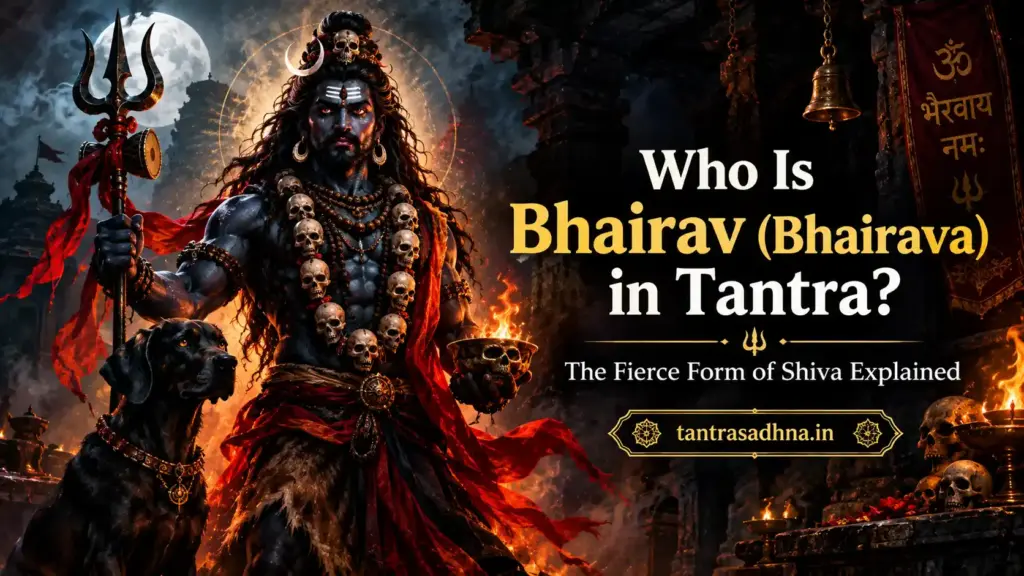
Bhairava is traditionally depicted with dark or blue-black complexion, wild hair, a garland of skulls, a trident, a skull cup (kapala), and dogs — particularly a black dog — as his vahana or companion. His gaze is direct, his expression is fierce, and his form is deliberately terrifying to the ordinary, comfort-seeking mind.
This iconography is not accidental, and it is not meant to be taken literally as a description of a deity who looks and behaves this way. In the symbolic language of Kashmir Shaivism, each element carries meaning:
- Dark complexion: Bhairava is not limited to or described by any visible form; darkness represents the infinite, the unmanifest ground prior to all forms.
- Skulls: The dissolution of ego-identities, of the limited self-concept. What the ordinary mind fears as death, Bhairava embodies as liberation.
- Trident (trishula): The three prongs traditionally represent the three fundamental energies — iccha (will), jnana (knowledge), and kriya (action) — or the three realms, all held in unified awareness.
- Skull cup: Consciousness that contains and “drinks” all experience without being disturbed by it.
- Dogs: In some readings, Bhairava’s companionship with the black dog signals that even the most instinctive aspects of existence are not excluded from the ground of awareness.
The fierce appearance is not an invitation to fear Bhairava — it is the tradition’s way of saying: this is not a consoling teaching. It is a radical one that requires facing what the ordinary mind runs from.
Bhairava in Kashmir Shaivism: Not a Deity But the Ground of Being
This is the key philosophical point, and it is what separates the Kashmir Shaivism understanding of Bhairava from popular or folk religious interpretations.
In Kashmir Shaivism, Bhairava is not a deity among deities — not a powerful divine being who exists somewhere above or apart from ordinary reality. Bhairava is the name given to pure, unlimited consciousness — the ground in which all experience arises, all phenomena appear, and all forms dissolve.
Shiva, in Kashmir Shaivism, is not a person but a principle: pure awareness, unchanging, the witness of all that occurs. Bhairava is Shiva in his totality — the recognition that this pure consciousness is not remote or separate from the ordinary mind, but is in fact what the ordinary mind is at its deepest level.
This is why the tradition is ultimately non-dualistic. The gulf that appears to exist between the individual consciousness and Bhairava is not an ontological gap — it is a perceptual one. The 112 techniques of the VBT are not methods for approaching Bhairava from a distance; they are methods for recognizing what is already present.
Bhairava and Bhairavi: The Structure of the Dialogue
The Vigyan Bhairav Tantra is structured as a dialogue. Bhairavi (also called Devi, or Parvati) asks Bhairava a series of questions about the nature of consciousness and how it can be recognized. Bhairava responds with 112 methods.
This structure is theologically precise, not decorative. Bhairavi represents Shakti — the dynamic energy of consciousness, the power of awareness in its active, questioning, world-engaged form. Bhairava represents Shiva — the still ground of pure consciousness. The dialogue between them is itself a teaching: the union of energy and awareness, of question and insight, of seeker and what is sought.
Bhairavi asking her question to Bhairava is not a lesser being petitioning a greater one. It is consciousness recognizing itself through the dynamic of inquiry. For more on this cosmological polarity, see the article on Shiva and Shakti in tantra.
Common Misconceptions About Bhairava
Bhairava is not a wrathful demon or malevolent spirit. In popular regional traditions, Bhairava is sometimes worshipped as a fierce protective deity or invoked for protection from negative forces. These traditions exist and have their own integrity. But in the philosophical tradition of the VBT, Bhairava is not a being to be propitiated — he is the nature of consciousness itself.
The fierce aspect is fierce only toward ignorance. What Bhairava’s form “destroys” is not individual practitioners but the fundamental confusion — the misidentification of consciousness with limited forms, thoughts, and roles. The fiercing is a metaphor for radical clarity, not violence.
Bhairava is not exclusive to fear-based practice. While the etymology touches on fear, the resolution of that fear into awe — and of awe into recognition — is the ultimate movement. The text is ultimately a text about joy (ananda), not terror.
Why This Matters for Practice
Understanding Bhairava philosophically changes how you relate to the 112 dharanas. These techniques are not rituals to please a fierce deity. They are doorways into recognizing what you already are at the level of pure awareness. The fierce form of the teacher is the tradition’s way of signaling: this recognition requires courage — the willingness to look past comfortable self-concepts into something vaster and less controllable.
That recognition is what the text calls Vigyan — direct knowing or direct experiential understanding. Not knowledge about Bhairava. Being Bhairava — recognizing that your own awareness is the ground the tradition calls by that name.
Frequently Asked Questions
Q: Is Bhairava the same as Shiva? In Kashmir Shaivism, Bhairava is understood as Shiva in his fullest, most complete expression — not a separate deity but Shiva as pure, all-encompassing consciousness. Other traditions within Shaivism may treat Bhairava as a distinct deity or as one of Shiva’s fiercer manifestations.
Q: Should I be afraid of working with Bhairava as a concept? No. The tradition is clear that the “fierce” quality of Bhairava points toward the dissolution of fear itself. Approaching the text and its techniques with sincere curiosity is entirely appropriate.
Q: Who is Bhairavi in relation to Bhairava? Bhairavi is the feminine counterpart — often identified with Parvati or Devi — and represents Shakti, the active energy of consciousness. In the VBT dialogue, she is the questioner who elicits the 112 techniques. She is not subordinate to Bhairava; together they represent the inseparable poles of consciousness and energy.
Q: Does one need to worship Bhairava to practice the VBT techniques? No. The techniques function as direct methods for centering awareness and do not require ritual worship. Understanding the philosophical significance of the name enriches the practice, but it is not a prerequisite.