112 Meditation Techniques of Vigyan Bhairav Tantra: The Complete Dharana Guide
The 112 meditation techniques of Vigyan Bhairav Tantra are among the most remarkable collections of practical meditation methods ever recorded. Set as a dialogue between Shiva and the Goddess Devi, this ancient text does not argue about the nature of reality — it hands you doorways into it, one technique at a time. This guide gives you a clear, honest overview of all 112 dharanas: what they are, how they are grouped, where they came from, and how to find the one technique that is right for you to begin with.
This is the hub page for our entire library of individual technique guides. Wherever a method is explained in depth elsewhere on the site, you’ll find a link to it below.
What Is the Vigyan Bhairav Tantra?
The Vigyan Bhairav Tantra (often shortened to VBT) is a foundational scripture of Kashmir Shaivism, the non-dualistic Shaiva tradition of Kashmir. It is traditionally regarded as the essence of the much larger Rudrayamala Tantra, which is now lost. The Sanskrit title is often rendered as “the science (vigyan) of consciousness,” reflecting its practical, experiential character.
The text takes the form of a conversation: the Goddess Devi (Bhairavi, the embodiment of energy) asks Bhairava (Shiva, pure consciousness) about the true nature of ultimate reality. Instead of answering with philosophy alone, Shiva responds with a series of dharanas — centering techniques, methods of focused awareness — that let the practitioner experience that reality directly rather than merely think about it.
A point worth being honest about: while the tradition counts 112 techniques, the exact count depends on how certain verses are read. Some single verses contain more than one method, and at least one foundational practice is spread across several verses. Different translators therefore number them slightly differently. We follow the widely used 112-technique enumeration while noting that the precise division is a matter of interpretation, not a fixed certainty.
Where the 112 Techniques Came From (Brief History)
For most of its history, the VBT was a closely held text within the Kashmir Shaiva lineage, transmitted from teacher to student. It reached a wide modern audience through two main routes.
First, Paul Reps included a rendering of the techniques, titled “Centering,” in his 1957 book Zen Flesh, Zen Bones, based on his contact with the Kashmiri master Swami Lakshmanjoo. Second, the spiritual teacher Osho devoted a long series of discourses (commonly cited as more than eighty) to these methods, later published as The Book of Secrets. Osho’s commentary is responsible for much of the text’s popularity today, though it is an interpretation rather than the scripture itself.
It’s worth keeping that distinction in mind throughout your study: the dharanas are very old, but most popular English presentations of them are 20th-century interpretations. Where a technique’s wording varies between sources, it is usually because translators and commentators have read the original Sanskrit differently.
How the 112 Dharanas Are Organized
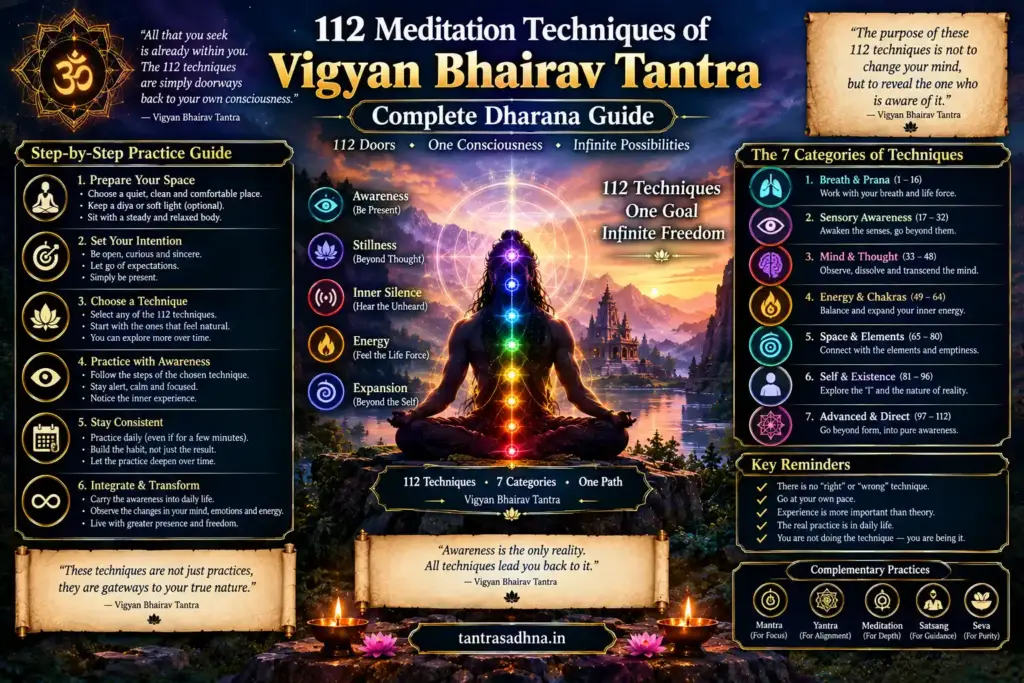
The original text does not sort the techniques into neat categories — they unfold naturally through the dialogue. But to actually practice them, it helps to group them by the “doorway” each one uses. Below is a practical grouping we use across this site. The numbers are approximate ranges, since, as noted above, enumerations differ.
| Group | Doorway used | What these techniques work with |
|---|---|---|
| Breath techniques | The breath and the pauses within it | The natural rhythm of inhalation, exhalation, and the gaps between |
| Sound and mantra techniques | Hearing, vibration, inner sound | AUM, Sanskrit letters, music, and the silence behind sound |
| Sight and light techniques | The eyes, gazing, visualized light | Outer objects, points of focus, darkness, and inner light |
| Body and energy-center techniques | The physical body and subtle centers | The spine, the navel, the space between the eyebrows, sensation |
| Awareness and void techniques | Attention itself | The gap between thoughts, witnessing, spaciousness, emptiness |
| Emotion and daily-life techniques | Feelings and ordinary experience | Desire, anger, joy, eating, and moments of everyday life |
Most people find that one or two of these doorways feel far more natural than the rest. That is exactly how the text intends it to work — no single technique is declared superior, and the practitioner is meant to find whichever method genuinely resonates and make it their own.
A Grouped Overview of the 112 Techniques
Below is an orientation to each group, with links to the in-depth guides we’ve published for individual dharanas. Rather than listing 112 one-line summaries (which tends to produce confusion rather than practice), we describe the character of each group so you can sense which fits you, then go deep on a specific method.
Breath-Based Dharanas
The breath is the most accessible doorway in the entire text, which is why the very first technique Shiva gives is a breath method. These dharanas don’t ask you to control the breath; they ask you to watch it — especially the subtle turning points where the in-breath becomes the out-breath and the out-breath becomes the in-breath. In the tantric view, these pauses are gaps where ordinary mental activity briefly falls silent.
If you are new to all of this, start here. Explore the breath-between-breaths technique and the meditation on the pause in breathing.
Sound and Mantra Dharanas
These techniques use hearing as the path. Some focus on a sound like AUM, following it from its audible form into ever-subtler vibration and finally into the silence it dissolves into. Others use the imagined sound of Sanskrit letters, or even ordinary music, as a way of dropping beneath the surface of the listening mind. The destination is the same: the soundless awareness behind all sound. See the sound and vibration dharana.
Sight and Light Dharanas
Here the eyes become the instrument. A practitioner might gaze steadily at an object until perception itself softens, rest attention in darkness with closed eyes, or contemplate an open, cloudless sky until awareness takes on the same boundless quality. These methods suit people who are strongly visual. Explore the meditation on darkness and the open-sky meditation.
Body and Energy-Center Dharanas
This is the largest and most varied family. Some techniques place attention on the navel center, the spine, or the space between the eyebrows (often associated with the ajna center). Others ask you to feel the body as limitlessly spacious, or to saturate every cell with a sense of stillness. These are the dharanas most often associated, in popular discussion, with subtle energy — which is precisely why they deserve a careful, non-sensational approach. Begin with the navel center dharana, the third-eye dharana, or the spine energy dharana.
Awareness and Void Dharanas
These are the most subtle methods, and often the most direct. Rather than giving attention an object, they turn attention back on itself. The classic example is resting in the gap between two thoughts — the brief, thought-free interval that already exists in everyone’s mind, usually unnoticed. Other techniques use the threshold of sleep, or the simple act of witnessing whatever arises. They tend to suit experienced meditators, though anyone can try them.
Emotion and Daily-Life Dharanas
One of the most striking features of the VBT is that it refuses to separate “spiritual” from “ordinary” experience. Several dharanas use strong emotion — desire, anger, even joy — as the doorway, asking you to stay fully aware in the feeling rather than acting it out or suppressing it. Others use everyday moments such as eating or the instant of waking. See the emotion-as-meditation dharana.
How to Choose Which Technique to Start With
With 112 options, the single most common mistake is trying many at once. The text’s own logic is the opposite: find one doorway that resonates, and stay with it long enough for it to deepen.
A simple way to choose:
- If you tend to be anxious or over-thinking, start with a breath technique — they are calming and concrete.
- If you are strongly visual, try a sight or light technique.
- If you respond to sound and music, the sound dharanas will feel natural.
- If you already have a steady meditation practice, the awareness and void techniques offer depth.
If you’d like this matched to you specifically, our technique finder walks you through a few questions and suggests where to begin. And before you commit to a regular practice, it’s worth reading our guide on how to practice Vigyan Bhairav Tantra meditation.
An Honest Note on Claims and Expectations
Because this is a spiritual text with a large popular following, it attracts a great deal of over-promising. It’s worth being clear-eyed.
The dharanas are traditionally believed to lead toward expanded awareness and, ultimately, self-realization. These are claims rooted in spiritual tradition and the reports of practitioners — they are not scientific findings, and no one can guarantee a particular experience or outcome on a particular timeline. Where modern research does support benefits, it generally concerns meditation in a general sense (for stress, attention, and emotional regulation), not the metaphysical claims of any specific lineage.
Be cautious of anyone selling guaranteed awakening, “instant” energy experiences, or paid shortcuts to spiritual powers. Genuine practice is slow, undramatic, and personal. If you live with a serious mental-health condition, treat intensive breath or energy practices with care and consult a qualified professional first — these techniques are not a substitute for medical or psychological treatment.
Approached patiently and honestly, the 112 techniques of the Vigyan Bhairav Tantra remain what they have been for centuries: a generous, practical map of doorways, with room for almost anyone to find a way in.
Frequently Asked Questions
How many meditation techniques are in the Vigyan Bhairav Tantra? The text is traditionally said to contain 112 meditation techniques, called dharanas. The exact count depends on interpretation, because some verses describe more than one method and at least one practice spans several verses, so different translators number them slightly differently.
What is a dharana in the Vigyan Bhairav Tantra? A dharana here means a centering technique — a specific method of focusing awareness, whether through breath, sound, sight, the body, or attention itself. Each dharana is meant to be practiced directly rather than just studied.
Who gave the 112 techniques and to whom? In the text, the techniques are given by Bhairava (Shiva, representing pure consciousness) in response to questions from the Goddess Devi or Bhairavi (representing energy). It is structured as a dialogue between them.
Do I need to practice all 112 techniques? No. The text does not present them as a checklist or a sequence. The intended approach is to find one technique that genuinely resonates with you and practice it consistently, rather than sampling many.
Is Osho’s Book of Secrets the same as the Vigyan Bhairav Tantra? Not exactly. The Book of Secrets is Osho’s series of discourses interpreting these techniques. It made the VBT widely known, but it is a commentary and interpretation, not the original scripture itself.
Are the 112 techniques scientifically proven to work? The spiritual claims associated with the dharanas are traditional beliefs, not scientific findings. Meditation in general has research support for benefits like reduced stress and improved attention, but specific metaphysical outcomes are not guaranteed and have not been scientifically established.