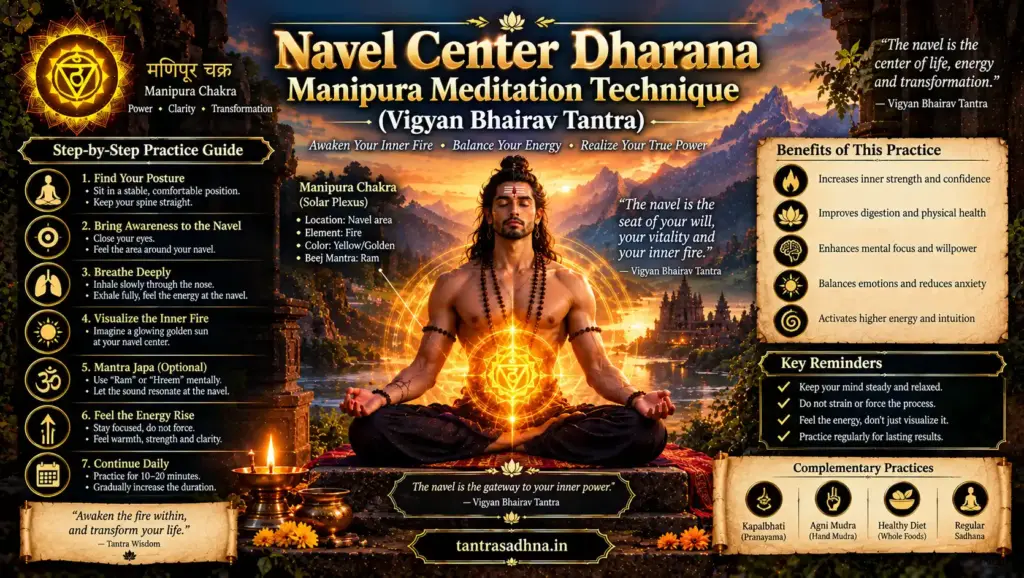
Navel Center Dharana – Manipura Meditation Technique (Vigyan Bhairav Tantra)
Among the body and energy-center techniques in the 112 dharanas of Vigyan Bhairav Tantra, one of the most foundational asks the practitioner to rest awareness at the navel center — the point the tantric traditions call nabhi or the manipura region. It is a practice of directed, sustained attention to a specific interior location in the body, and it is both simpler and more demanding than it might first sound.
What the Text Instructs
The relevant verse instructs the practitioner to rest attention at the navel (nabhi), which is understood not merely as the physical navel but as the entire region of the solar plexus and the energetic center associated with it. The instruction is placement — not visualization of a color, not construction of a spinning wheel, not performance of any particular breathing pattern. Just attention, resting at the center of the body.
This simplicity is worth emphasizing. The dharana’s instruction is complete. Nothing else is prescribed or required.
The Tantric Understanding of the Navel Center
In the Kashmir Shaiva framework and in the broader Indian yogic tradition, the navel is understood as the origin point of the body — the place to which the umbilical cord was attached, through which nourishment and life first arrived. Beyond this biological fact, the navel region is regarded as the seat of prana in the body’s energetic anatomy: the gathering point through which life force distributes itself to the rest of the system.
The manipura (sometimes spelled manipuraka) is the energy center most commonly associated with this region in the chakra model. In Sanskrit, the name is often translated as “city of jewels” — a name that points to the tradition’s regard for this center as a place of power, vitality, and will. In the Vigyan Bhairav Tantra, however, the instruction does not ask you to work with the chakra as a conceptual object. There is no instruction to visualize a yellow lotus, to count petals, or to activate anything. The practice is simpler and more direct than popular chakra-activation frameworks suggest.
It is worth being clear about this: the traditional claim that this dharana works with the body’s energetic center belongs to the belief system of Kashmir Shaivism. Modern science has not confirmed the existence of chakras or prana as anatomical or physiological structures. If you approach this practice with an open, curious quality of attention rather than with expectation of specific energy experiences, you are likely to find it more useful.
Locating the Center
Before beginning the practice, it is worth spending a few moments finding the correct location of attention.
The physical navel is the starting reference, but the quality of attention in this dharana rests slightly inside the body — behind the navel, in the region of the solar plexus. Many practitioners describe this as resting attention at a point roughly four to five centimeters (two inches) behind the surface of the skin, at the level of the navel. Others simply rest attention at the navel itself, neither forcing the focus inward nor outward, and allow the quality of internalization to develop naturally.
There is no single “correct” depth. What matters is that the attention has a stable, interior quality — not vague or scattered, but also not strained or tightly focused. Think of it as resting your awareness gently on a warm stone at the center of your body.
Practice Instructions
Sit in a position you can maintain comfortably for fifteen to twenty minutes. Spine upright, body relaxed, eyes closed.
Spend two or three minutes letting ordinary mental agitation settle. Natural breathing, no control.
Then bring attention, gently and clearly, to the navel region. Rest it there. Do not attempt to observe breath at this point — the breath awareness was for settling. Now, the object of attention is the interior space of the navel center itself.
The quality of attention matters more than the precision of location. If you spend five minutes trying to identify the exact millimeter of the “right” spot, you have already missed the practice. Place attention in the general region and let it settle. The sensation of placement — a gentle warmth, a sense of weight, a subtle fullness — typically develops on its own when attention rests consistently.
When the mind wanders (and it will), notice where it has gone, and bring it back to the navel center. This returning is not a failure; it is the core motion of the practice.
A sitting of twenty to thirty minutes is appropriate for most practitioners. Consistency over weeks matters more than duration in a single session.
Experiences Practitioners Report
Practitioners who work with this dharana over sustained periods typically report a few recurring phenomena. These are honest descriptions of practitioner experience — they are not claims of guaranteed outcomes, and they vary considerably between individuals.
Warmth or heaviness in the navel region. This is among the most commonly reported experiences, usually appearing within the first several weeks of regular practice. Whether this reflects a change in blood flow, a relaxation of the abdominal muscles that normally hold tension, or something else is not known.
A sense of groundedness or centeredness. Many practitioners describe feeling more stable and settled, both during and after practice sessions. This quality tends to extend into ordinary daily activity.
Reduced mental scatter. Resting attention at a fixed interior point — rather than following thoughts — trains a kind of focused, interior quality of attention. Over time, this is commonly experienced as less mental noise.
What practitioners generally do not reliably report, despite popular chakra-activation claims, is spontaneous dramatic energy experiences, sudden emotional purges, or life-altering transformations on a predictable timeline. Such experiences may or may not occur in practice; treating them as the goal or sign of success tends to distort the practice.
Distinguishing This From Chakra-Activation Practices
Popular chakra work often involves visualization (a glowing yellow disc), affirmations (“my power center is open”), color imagery, or seed-mantra repetition (RAM for manipura). These are valid methods within their own frameworks, but they are not what this dharana describes.
The navel-center dharana of the Vigyan Bhairav Tantra is a placement practice: the only instruction is to rest awareness at the center. No imagery, no mantra, no special breathing. The assumption behind this simplicity is that awareness itself, when given a stable interior resting place, naturally deepens and clarifies — without requiring supplementary techniques. If you want to explore body-center techniques from a different angle, a companion practice worth knowing is the third-eye dharana (covered in a forthcoming guide), which uses the same principle of placement but with attention directed to the ajna center at the forehead.
How Long to Practice
Practice this dharana daily for a minimum of forty days before drawing firm conclusions. A single sitting of fifteen to twenty-five minutes is sufficient. The qualities that practitioners describe — settledness, warmth, interior stability — tend to develop gradually and cumulate rather than appearing in a single breakthrough session.
For support in structuring your practice alongside other techniques or daily responsibilities, see how to practice Vigyan Bhairav Tantra meditation.
Frequently Asked Questions
Do I need to breathe in a special way during this dharana? No. The breath should remain natural throughout. The attention is on the navel center, not on the breath. You may notice the breath moving the belly and navel region — that is fine; simply keep the primary object of attention the center itself, not the movement.
What if I feel nothing at the navel center? This is common in the early weeks. The capacity to sense the interior of the body is a skill that develops with practice. Continue placing attention at the navel with a relaxed, curious quality. Expecting or straining to produce a sensation tends to prevent one from developing naturally.
Is this the same as core breathing or diaphragmatic awareness exercises? Not exactly, though the navel region is also central to those practices. The dharana’s aim is interior awareness rather than muscular or respiratory function. There is likely some overlap, but the intent and quality of attention differ.
Is this dharana safe for beginners? Yes. Unlike some breath-retention or intensive visualization practices, this dharana involves no unusual physical demands. It is a placement of simple awareness and is appropriate for practitioners at any level.
How does the navel center dharana relate to the other 112 techniques? It belongs to the family of body and energy-center dharanas within the VBT. For a complete picture of how all the dharanas are grouped and where the navel technique fits, see the full dharana guide.
Can I combine this with a chakra-balancing practice I already do? The tradition generally recommends working with one technique at a time to develop real depth in it. Combining multiple methods often fragments attention rather than deepening it. If you have an established chakra practice, consider keeping that in a separate session and treating this dharana as its own distinct practice.