Breath Between Breaths Dharana – The First Technique of Vigyan Bhairav Tantra
Of the 112 meditation techniques of Vigyan Bhairav Tantra, the very first one is a breath technique. That is not a coincidence. Shiva opens with breath because breath is the one thing every human being is already doing, all day long, without pause. You do not have to construct a special inner object. The doorway is already moving.
What makes this dharana unusual is what it asks you to attend to. It does not say “follow the breath.” It says: find where the breath turns.
What Shiva Actually Instructs
The relevant verse from the Vigyan Bhairav Tantra (verse 2, in most enumerations) can be rendered roughly as:
“Radiant one, this experience may dawn between two breaths. After the in-breath comes and just before the out-breath begins — the beneficence.”
The Sanskrit word often translated as “turning point” or “between” refers to the momentary reversal that takes place at the very top of the inhalation, before the lungs begin to empty. The same turning occurs at the bottom of the exhalation, before the lungs begin to fill again. Neither of these moments is a dramatic pause — they last only a fraction of a second under ordinary conditions. The instruction is simply to notice them.
This is a significant shift. Most breathing instructions tell you to observe the whole breath — the rise and fall, the sensation at the nostrils, the movement of the belly. This dharana redirects your attention to the moment of reversal itself. It asks you to be present at the precise instant where the in-breath ends and has not yet become the out-breath.
The Tantric Understanding of the Gap
In the Kashmir Shaiva view that underlies the Vigyan Bhairav Tantra, ordinary waking consciousness is a continuous movement — a stream of content, thought, sensation, and memory that never fully stops. What briefly interrupts this stream is what makes the turning point of breath significant. At the exact moment of reversal, there is traditionally said to be a natural cessation: the breath has neither begun nor ended, it is going neither in nor out, and ordinary mental momentum pauses with it.
This gap is understood not as an absence but as the nature of awareness itself — what remains when the movements of mind and breath both temporarily stop. Practitioners across the Kashmir Shaiva tradition have described these moments as brief, uninstructed tastes of the silence that underlies all experience. Whether you accept that framing or not, there is something pragmatically useful here: the turning point of breath is a precise, recurring, natural event that can function as an anchor for attention.
Exact Practice Instructions
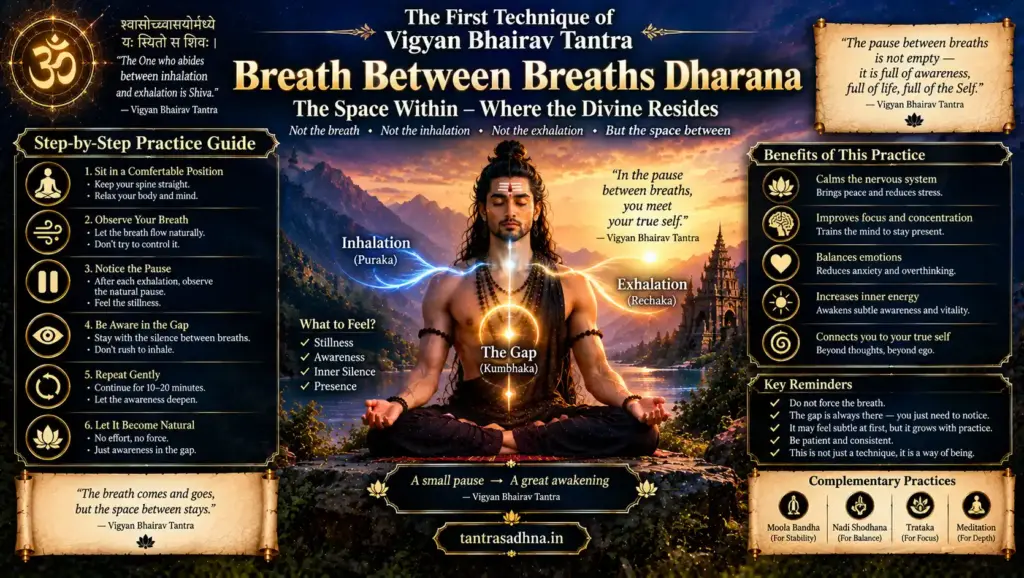
Sit comfortably in a position you can maintain without fidgeting. Close your eyes. Spend two or three minutes simply becoming aware of natural breath without trying to change it at all.
Then gently shift the quality of your attention. Rather than tracking the breath through its whole length, wait for the moment of turning — specifically:
- At the end of the in-breath: as inhalation completes, notice the fraction of a second when the breath is neither going in nor going out. Do not hold the breath. Simply catch the natural stillness.
- At the end of the out-breath: as exhalation completes, notice the fraction of a second when no new breath has started. Again, do not hold. Simply be present at that threshold.
Your job is not to extend these moments or create them — only to notice them as they happen naturally. The moment you start manufacturing a pause, you have left the practice. Return to noticing, not controlling.
Do this for fifteen to twenty minutes in a single sitting. As your concentration develops over days and weeks, these fractions of a second may seem to grow more vivid — not because the gap is objectively longer, but because your ability to be present in it has deepened.
Why the Turnaround Point Matters
Most forms of meditation use a continuous object of attention — the breath as a whole, a mantra, a visualized image. This works well because continuity keeps the mind occupied. The breath-between-breaths dharana takes a different approach: it asks you to find the break in continuity. That break requires a different quality of attention — one that is sharp rather than flowing, present rather than tracking.
Practitioners report that this quality of attention, once developed at the turning point of breath, begins to extend naturally into the rest of practice and even daily life. The same sharpness that can catch a half-second gap in the breath can catch the gap between a stimulus and your habitual reaction to it. Whether you understand this in tantric terms or simply as an improvement in attentional precision, the skill being trained is real.
Common Mistakes
Trying to hold the breath. The dharana is about noticing the natural pause, not creating an artificial one. Breath retention (kumbhaka) is a separate practice with its own methods — see the companion guide meditation on the pause in breathing. If you find yourself retaining the breath, relax the instruction and return to observation only.
Watching the breath rather than the turn. A very common drift: within a few minutes, attention slides back to tracking the full arc of inhalation and exhalation. When you notice this, gently redirect. You are waiting for the turn, not following the journey.
Expecting a dramatic experience. The gap is subtle. Beginners often spend weeks before they sense anything noticeably different at the turning point. This is normal. The practice is not about manufacturing an experience; it is about developing the precision to be present at a very fine event.
Sitting for too long too soon. Twenty minutes is sufficient to begin. Sitting for an hour with poor concentration produces less than twenty minutes with genuine attention.
What to Expect Over Time
Early in practice, you may notice that the turning points pass almost too quickly to register. That is accurate — they are short. Over several weeks of regular sitting, practitioners typically report that the gaps seem more vivid and that there is a natural settling of mental activity around them.
The traditional claim is that, with sustained practice, the gap can become a doorway into a state of awareness that is quieter than ordinary waking consciousness — what the texts call turiya, or the “fourth state.” This is a traditional belief of the Kashmir Shaiva lineage, not a guaranteed outcome. What most sincere practitioners do report is a gradual improvement in the quality of attention, a reduction in habitual mental noise, and a greater sense of ease in daily life.
How Long to Practice
Most teachers in this tradition recommend practicing a single technique consistently for at least forty days before drawing conclusions about whether it is working for you. Daily practice of fifteen to twenty minutes is more useful than occasional long sessions.
If you are new to meditation and want to understand how to structure a sustainable practice, see our guide on how to practice Vigyan Bhairav Tantra meditation before you begin.
Frequently Asked Questions
Do I need to breathe in a special way for this dharana? No. The breath should remain completely natural throughout. If you find yourself manipulating the rhythm, depth, or rate of breathing, release the control. The instruction is to observe the turning point, not to engineer it.
What is the difference between this technique and the pause in breathing dharana? This dharana attends to the instantaneous moment of reversal — the turning of the breath at the top and bottom of the cycle. The companion technique, meditation on the pause in breathing, works with a more sustained resting of awareness in the natural pause. They are closely related and complement each other.
I keep forgetting to watch the turning point and end up tracking the full breath. Is that a problem? It is very common, especially in early weeks. Simply notice that you have drifted and return attention to the moment of reversal. The ability to notice that you have drifted is itself part of the practice.
Can I combine this with a mantra or pranayama? The VBT tradition generally recommends practicing one technique fully rather than combining methods. If you are already working with a pranayama routine, it can be useful to practice this dharana as a separate, shorter session.
How is this related to the other 112 techniques? This is the first of the breath-based dharanas in the Vigyan Bhairav Tantra. For a full overview of how all 112 techniques are grouped and how to choose among them, see the complete dharana guide.
Is this safe for beginners? Yes, this is one of the most accessible techniques in the entire text. It requires no unusual breath control, no visualization, and no prior meditation experience. It is a straightforward observation practice.