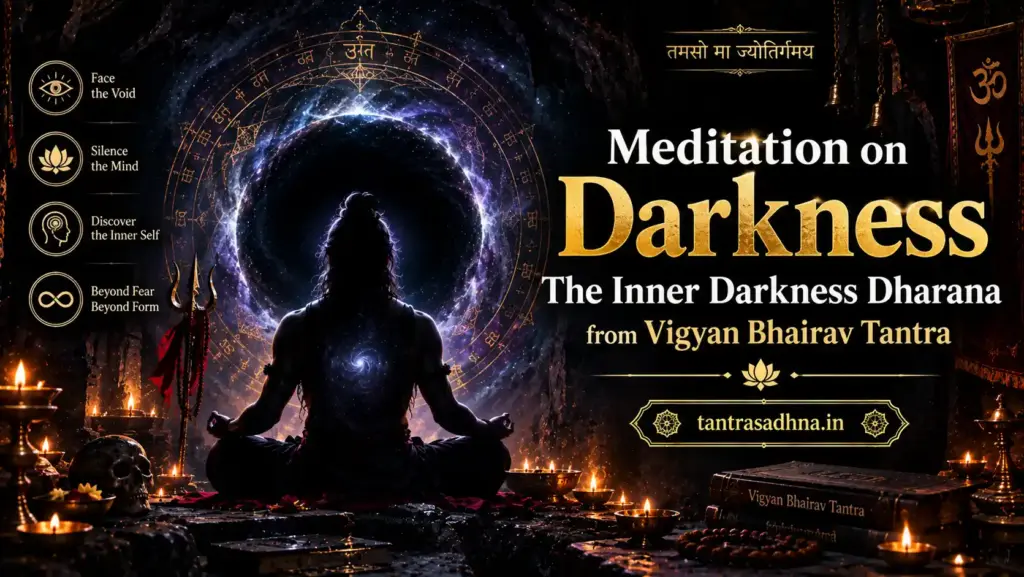
Meditation on Darkness – The Inner Darkness Dharana from Vigyan Bhairav Tantra
Not all dharanas in the 112 techniques of Vigyan Bhairav Tantra are widely known. The darkness dharana is one of the less prominently discussed, yet practitioners who have worked with it consistently report that it is among the most stabilizing techniques the text offers — particularly for those whose minds tend toward visual restlessness or who find concentration on internal objects difficult to sustain.
The instruction, in its simplest form, is this: close the eyes, rest awareness in the darkness, and allow that darkness to expand from a limited “black behind the eyelids” into something spacious, boundless, and unbounded.
What the Practice Involves
The entry point is ordinary: you close your eyes, and you see darkness. Most people, when they close their eyes to meditate, treat this darkness as a background to be moved past — a neutral screen on which thoughts appear, or an empty space waiting to be filled with breath-counting, mantra, or visualization. The darkness dharana inverts this orientation. The darkness is not the backdrop. It is the object.
Begin by simply resting in what is already there — the field of darkness that appears behind closed eyes. Do not try to see anything in it. Do not try to deepen or extend it. Simply rest in it as it is: dark, still, present.
After some time — for some practitioners a few minutes, for others longer — the quality of the darkness begins to shift. The initial experience of “black in front of me” starts to open. The sense of a surface dissolves. What remains is the quality of darkness itself, which practitioners typically describe not as a wall of black but as a vast, unbounded, open space — the same darkness that fills a clear night sky before the mind adds any interpretation.
The practice is to remain in that quality as it unfolds naturally, without forcing either its arrival or its continuation.
Temperaments Well Suited to This Dharana
The darkness dharana tends to suit particular kinds of practitioners — those for whom visual complexity in the inner field is a source of distraction rather than deepening.
Some practitioners, when they close their eyes to meditate, encounter a busy visual field: light, color, movement, shapes, imagery. For these practitioners, techniques that use an interior visual object — a visualization, a symbol, a point of light — can generate engagement with the visual noise rather than settling beneath it. The darkness dharana sidesteps this difficulty entirely. Its object is not a form in the field but the field itself — the unstructured darkness that contains whatever visual activity may appear.
Similarly, practitioners who find silence uncomfortable, or who report feeling “lost” in purely open-awareness practices, often find the darkness dharana a useful middle ground. The darkness provides a stable, present quality to rest in — it is always there when the eyes are closed — without being so featureless that attention has nothing at all to return to.
The Tantric Understanding of Inner Darkness
Popular usage in many traditions frames darkness negatively — as ignorance, evil, or unconsciousness. The Vigyan Bhairav Tantra takes a different position.
In the Kashmir Shaiva understanding, darkness is not the absence of light — it is the ground that precedes both light and darkness as qualities. The inner darkness encountered in this dharana is associated with the concept of tamas as a quality of depth and stillness rather than inertia or heaviness. More significantly, the tradition understands the inner darkness as not being nothing — it is, in the tantric view, a form of pure awareness that has no content, and is therefore the closest analog in ordinary experience to the nature of consciousness itself.
This is a metaphysical claim of the tradition. Whether the practitioner holds it or not, the practice is available. What can be observed is that sustained attention to the inner darkness does produce an observable quality of spaciousness and settledness in most practitioners who stay with it long enough for it to develop.
Exact Practice Instructions
Sit in a position you can hold comfortably for twenty to thirty minutes. Spine upright, body relaxed. Dim the room if possible — a fully dark room is ideal but not required. Close the eyes gently.
Spend the first two to three minutes allowing the surface activity of the mind to settle without trying to manage it. Natural breath, no instruction.
Then bring attention to the field of darkness behind the closed eyes. Not to anything appearing in the field — not to thoughts, images, or visual noise — but to the darkness itself as a quality of the field.
Rest there. Let the attention be soft and spacious rather than focused and pointed. This is not an exercise in concentration on a pinpoint object; it is an exercise in resting in an unbounded quality. The more the attention relaxes into the darkness rather than focusing on it, the more the spacious quality described by experienced practitioners tends to emerge.
When the eyes want to flicker or open. This is common in early practice and is usually a signal of restlessness rather than a problem with the technique. Do not force the eyes still through effort — this creates tension in the face. Instead, soften the quality of attention and let the eyes rest wherever they naturally settle. The practice is happening in awareness, not in the physical eyes.
When thoughts or images appear in the field. Let them be there without engaging. They are appearing in the darkness — the darkness continues. Return attention to the quality of the field itself, not to what is appearing within it.
When restlessness arises. This is the most common difficulty and is usually most acute in the first ten to fifteen minutes. The instruction is to allow the restlessness without acting on it. Sit through it with the darkness as your companion rather than distraction as an escape.
Caution Regarding Forced Visions
Some practitioners, upon hearing about the darkness dharana, expect to produce visions — experiences of inner light, imagery, or altered visual states. Approaching the practice with this expectation tends to undermine it. The dharana does not aim at vision-production. Visions may or may not arise. If they do, the instruction is the same as for any content that appears in the field: note it, and return attention to the quality of the darkness itself.
Forcing or straining to produce visual experiences can create eye tension, headache, or a frustrated quality of sitting that becomes self-defeating. The darkness dharana is, at its best, a deeply restful practice. If it is becoming effortful and strained, ease the quality of attention significantly.
Relation to Other Dharanas
The darkness dharana belongs to the family of sense-withdrawal and space-based techniques in the Vigyan Bhairav Tantra. Its natural companions are the sound vibration dharana — which follows a similar interior quality (subtle sound) rather than an object — and the open sky meditation dharana, which works with the opposite quality: open, light-filled space rather than closed, dark space. Some practitioners alternate between these two techniques across sessions and find the contrast illuminating.
For full context on where this practice fits within the 112 techniques, see the complete dharana guide. For guidance on structuring your practice, see how to practice Vigyan Bhairav Tantra.
Frequently Asked Questions
Do I need a completely dark room? A darkened room helps in early practice because it reduces the stimulation reaching the eyes through closed lids. But it is not strictly required. Many practitioners work with this dharana in ordinarily lit rooms with eyes closed. The key is the quality of interior attention, not the degree of external darkness.
What does it mean for the darkness to “expand”? Is that something I do or something that happens? It is something that happens when the quality of resting attention is right. You cannot force the expansion — the attempt to produce it through effort tends to contract the field rather than open it. The instruction is to rest in the darkness as it is, and allow any change in quality to arise on its own terms.
I see a lot of color and light even with my eyes closed. Is this dharana still suitable for me? Yes — in fact, those who experience a busy visual field with closed eyes are often well suited to this dharana precisely because it trains attention to rest in the field itself rather than in its contents. The colors and lights are appearing in the darkness. The darkness precedes and contains them. Practice resting there.
How is this different from simply sleeping with eyes closed? The quality of attention is entirely different. In sleep, awareness withdraws. In this dharana, awareness is present and intentional — it is resting in the darkness rather than dissolving into it. If you find yourself drifting toward sleep, an upright posture with eyes gently tilted slightly upward (not straining) tends to maintain wakefulness.
Is darkness meditation safe for people who are afraid of the dark? If darkness as a quality produces fear or distress rather than settledness, this may not be the right entry point. Other techniques — such as breath-based dharanas or sound techniques — may be more appropriate. The goal is a quality of restful, spacious resting, not confrontation with psychological difficulty. If uncertainty exists about which technique suits your temperament, see choose your meditation technique.
How long until the spacious quality described by practitioners develops? This varies. Some practitioners report it emerging within the first few sittings; for others it develops gradually over several weeks of regular practice. Forty days of consistent daily practice is a reasonable minimum before drawing conclusions about whether this technique suits you.