Using Emotions as Meditation – The Emotion-as-Doorway Dharana (Vigyan Bhairav Tantra)
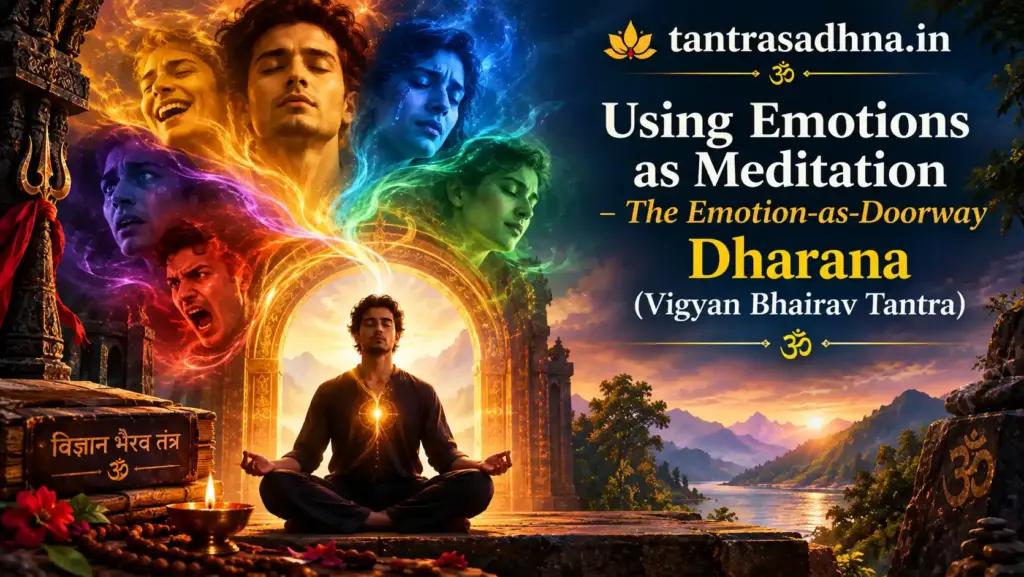
One of the most distinctive features of the 112 dharanas of Vigyan Bhairav Tantra is the presence of techniques that work directly with emotional states as meditation objects. Where many meditative traditions instruct the practitioner to become calm, to set emotions aside, or to work with strong feelings only after achieving a stable foundation of tranquility, the Vigyan Bhairav Tantra takes a different approach: it asks the practitioner to use the energy of emotion — desire, anger, joy, jealousy, grief — as the doorway itself.
This is not a relaxation technique. It is a technique of radical presence.
What the Text Instructs
The relevant verses in the Vigyan Bhairav Tantra describe a method of turning toward strong emotion and fully inhabiting it as pure energy — without following the story that the emotion is telling, without acting the emotion out, and without suppressing or pushing it away.
The instruction points to the feeling as a sensation, a quality of energy in the body, prior to the meaning the mind attaches to it. Anger, before the narrative of what the other person did and what you should say, is a physical and energetic event — heat, contraction, upward movement of pressure, heightened alertness. Desire, before the story of its object, is a pull, a seeking quality, a warmth or urgency in the body. The dharana asks the practitioner to rest in that raw felt quality — the pure energy of the emotion — and remain there.
The Tantric Logic
The Vigyan Bhairav Tantra operates within a framework that understands all experience as expressions of shakti — the dynamic energy of consciousness. In this view, emotions are not distortions of awareness or problems to be managed. They are concentrations of the same energy that gives rise to all experience.
When a strong emotion arises and the practitioner reacts — acts it out, suppresses it, or analyzes it — the energy of that emotion is dispersed and transformed into behavior, story, or physical tension. None of this dispersal brings the practitioner closer to the source from which the emotion arose.
The dharana proposes something different: instead of dispersing the energy of emotion outward into reaction or inward into suppression, turn the full quality of awareness toward the feeling itself. Rest in it. This is traditionally said to reveal the emotion as what it always was — concentrated shakti — rather than the personal wound or moral failing the thinking mind interprets it as.
These are experiential and metaphysical claims of the Kashmir Shaiva tradition. Individual practitioners report experiences consistent with this framing, but outcomes vary, and the claims belong to a spiritual framework rather than to clinical psychology.
Practicing with Anger
When anger arises, the habitual response is almost immediate: the mind begins constructing the narrative of why the anger is justified, who is to blame, what should be said or done. This narrative is not the anger itself — it is what the thinking mind does with the energy of anger.
The anger dharana interrupts this reflex. When you notice anger arising — in the body, before the story has fully formed — pause. Bring attention to the felt sensation of the anger: the tightening in the chest or throat, the heat in the face, the tension in the shoulders and jaw, the upward surge of energy. Rest attention there, in those physical sensations. Do not narrate. Do not ask whether you are justified or what you should say. The practice is to stay with the feeling as sensation, without acting and without building the story.
Practitioners commonly report that anger, when met this way, moves — it intensifies briefly and then shifts, often revealing something underneath (frequently hurt or fear) that the anger’s forward momentum was covering. The goal is not to make the anger dissolve. The goal is full presence in it.
Practicing with Desire
Desire — particularly intense wanting or longing — is the other emotion most explicitly addressed in the relevant VBT verses. Ordinarily, desire rivets attention on its object: the person, the outcome, the thing. The feeling of desire itself is treated as a means to an end rather than as an experience in its own right.
The desire dharana reverses this: withdraw attention from the desired object and turn it toward the quality of desire itself. What does wanting feel like, in the body, as a felt sensation rather than a thought directed at something?
Most practitioners find that desire, as a bare sensation, is quite alive — a warmth, a reaching quality, an urgency in the chest or belly — and quite distinct from the mental activity of planning or seeking. The tradition suggests that when desire is inhabited as energy rather than followed toward an object, practitioners may find a quality of aliveness that does not depend on any particular outcome. This is a traditional claim and an experiential report, not a guaranteed result.
The Crucial Distinction: Witnessing Versus Dissociating
This distinction is the most important thing to understand about emotion-as-meditation practice, and it is where the practice is most easily misapplied.
Witnessing means full presence in the emotion — turning attention toward the feeling, inhabiting it directly, experiencing its physical and energetic qualities without buffer or delay. The witness is in the fire.
Dissociation means withdrawing from the emotion — creating distance from it, observing it from behind glass, numbing or removing oneself from its felt quality. The dissociated observer is outside the fire, watching it from a safe remove.
These are experientially opposite. They can look similar from the outside — in both cases, the person is not acting the emotion out — but inwardly they are entirely different. Witnessing is a heightened presence; dissociation is a defensive absence.
If a practitioner uses the language of “being a witness” to avoid feeling an emotion more fully — if “witnessing” becomes a way to stay safely above or away from the feeling — that is dissociation, not dharana. The practice asks for more contact with the emotion, not less.
Who This Technique Suits — And Important Cautions
The emotion dharanas are well-suited to practitioners who already have significant emotional intensity in their lives and are looking for a different relationship to that energy. They are also accessible to practitioners with some prior meditation foundation.
These techniques are not recommended as an early or primary practice for those currently experiencing acute emotional crises, recent trauma, or those with conditions where emotional regulation is already significantly impaired. This is not therapy. The emotion dharanas work with the energy of healthy emotional experience — strong but within the ordinary range of human feeling. They are not a substitute for professional mental health support.
If you find emotions arising with unusual intensity — flashbacks, dissociative episodes, or anything that feels outside ordinary feeling — stop, and seek support from a qualified professional. For guidance on finding a qualified meditation guide for this type of practice, see why a guide for tantra.
Emotion as Doorway — Not as Problem
In the VBT’s approach, no emotion is a problem to be solved. Each emotion is a doorway — an intensification of energy that, if met with full awareness rather than with reaction, can open into something deeper. The practitioner is not trying to produce good emotions and eliminate bad ones. The aim is the capacity to be fully present in the feeling of being alive — which includes the full range of human emotional experience.
For the structural overlap between this approach and other awareness-based techniques in the VBT, see the gap between thoughts meditation — both involve resting in what is present without addition or subtraction. For support with anxiety in a meditation context, see meditation for anxiety — tantra approach. For the full context of these techniques within the 112, see the complete dharana guide.
Frequently Asked Questions
Does this mean I should feel my emotions more intensely, or not act on them? Both, in a sense. The practice asks for more presence in the feeling and less automatic behavioral response. These are not contradictory. You turn toward the emotion more fully in awareness, which means you are less likely to discharge it automatically through reaction. The intensity is felt rather than acted.
What if I find myself dissociating instead of witnessing? This is common, especially early in practice. If you notice a flat, deadened, or too-calm quality when working with a strong emotion, it is likely that avoidance is operating rather than witnessing. Come closer — lean into the physical sensations of the feeling rather than observing from a distance. If genuine dissociation is a pattern for you, working with a therapist alongside meditation practice is advisable.
Can I use this technique during an argument or a difficult conversation? With some practice, yes — though it is demanding. The capacity to be fully present in anger or hurt during a live interpersonal situation, without either suppressing it or discharging it reactively, develops over time. Early in practice, it is more accessible to work with emotional residue after a situation has passed, or to notice and work with the body’s emotional response when it arises in quieter circumstances.
Is this technique appropriate during grief? Grief is one of the emotions the tradition acknowledges as accessible through this type of practice, and many practitioners find this approach genuinely helpful in processing grief — not to make it go away, but to inhabit it more fully and allow it to move. However, if grief is very raw and acute, gentler support — human, therapeutic, or community-based — should come first.
How is this different from simply venting or indulging emotions? The difference is the quality of awareness. Venting is discharge — the emotion drives behavior and expression without awareness of the emotion itself. Indulgence is following the emotion’s narrative and building on it. This dharana is neither: it is awareness turned toward the energy of the feeling, without acting and without narrating. The emotion is the object of attention, not the subject that drives behavior.
How does this fit within the 112 techniques overall? The emotion dharanas represent one of the most distinctive clusters within the Vigyan Bhairav Tantra — the understanding that ordinary life experiences (emotions, movement, sleep, sensation) can themselves be the practice, without requiring formal separation from the world. For the full map of how these techniques relate to each other, see the 112 dharanas guide.