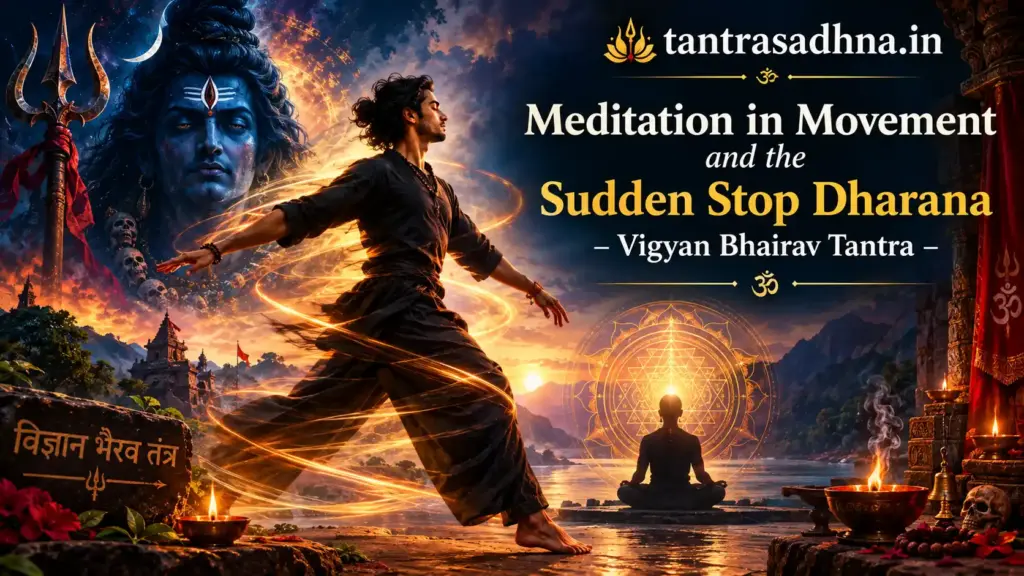
Meditation in Movement and the Sudden Stop Dharana – Vigyan Bhairav Tantra
Not all meditation in the Vigyan Bhairav Tantra is practiced sitting still. Several of the 112 dharanas use the body in motion — walking, running, dancing — as the field of practice. Two of these stand out as particularly accessible and instructive for the modern practitioner: the technique of full awareness in movement, and the technique of sudden cessation — movement followed by an abrupt stop.
Both are practical. Both can be done anywhere. And both are pointing toward the same insight from different directions.
Dharana One: Full Awareness in Movement
What the Text Instructs
The instruction in this family of dharanas is to remain fully present in the continuous flow of physical sensation that movement produces. Walking, running, dancing — any sustained movement qualifies. The object of attention is not any single sensation but the whole flowing field of sensation arising from the moving body: the contact of the feet with the ground, the swing of the arms, the rhythm of the breath, the interplay of muscle and momentum, the micro-adjustments of balance.
The practice is not visualization, not mantra, not watching the breath. It is direct, complete sensory presence in the physical experience of movement as it unfolds from moment to moment.
The Tantric Logic
In ordinary movement, the body is in motion but attention is elsewhere: planning the next activity, replaying a conversation, generating commentary about what is happening. The body is a vehicle the mind uses to get somewhere else.
The movement dharana reverses this. The moving body is not a vehicle — it is the entire object. The flowing, continuous, never-identical cascade of physical sensation produced by movement becomes the ground of awareness. From the Vigyan Bhairav Tantra’s perspective, complete sensory presence in any experience — including the experience of movement — is itself a valid and complete entry point into meditative depth. The body in motion provides a rich, constant, varied stream of present-moment sensation. It leaves the thinking mind very little room to wander.
Practical Instructions
Walking awareness. Begin walking at a natural pace — slightly slower than ordinary is useful in early practice. Direct attention entirely to the physical experience of walking: the lifting and placement of each foot, the shifting of weight, the movement of the body through space, the air on the skin. When attention moves to thinking or narrating, return to the felt experience of the moving body. The returning is the practice.
Running or vigorous movement. Running produces a higher-intensity version of the same field of awareness. The proprioceptive feedback is more insistent and harder to ignore, which some practitioners find makes presence easier rather than harder. The instruction is the same: complete attention to the immediate physical experience of moving.
Dance or free movement. Unstructured, improvisational movement — without choreography — is an especially rich field for this practice. Attention rides the continuous improvisation of the moving body. Practitioners report states of absorbed presence distinct from both ordinary dancing and ordinary sitting meditation.
Duration and setting. Twenty to forty-five minutes is appropriate. Practice in a space where you will not need to navigate traffic or social interaction, at least in the early stages.
Dharana Two: The Sudden Stop
What the Text Instructs
This is the dharana that stops. The instruction: move — walk, run, gesture, or engage in any physical activity — and then stop, abruptly and completely, without winding down or slowing gradually. From movement to stillness in a single moment.
That moment of sudden stillness is the object of practice.
The Tantric Logic
Movement builds a particular quality of attention: gathered, alert, present in the body, tracking a continuous flow of sensation. This state is quite different from the ordinary resting mind, which is usually drifting, planning, or narrating. Movement creates a heightened quality of awareness through the sheer demand of physical activity on the attentional system.
When movement stops suddenly — not fading gradually but ceasing all at once — this heightened awareness momentarily has no object to track. The body is still. The flow of sensation from movement has stopped. But the quality of gathered, alert attention built up during movement is still present, for a brief window before the thinking mind fills the space with commentary.
That brief window — the moment of stillness immediately after sudden cessation of movement — is what the tradition identifies as the doorway. In that instant, practitioners report a quality of heightened, clear awareness that is distinctly different from ordinary stillness: alert, spacious, and (even if only briefly) free of the usual commentary.
The technique uses the body’s own physics to produce a temporary condition of clarity.
How to Practice
Simple version. While walking, stop mid-stride without slowing down first. Both feet find the ground. Stillness. Stay with the quality of the moment — the heightened alertness still present from movement, the sudden absence of physical input, the brief space before thought rushes in.
Hold the stillness until the moment’s quality passes naturally — usually five to thirty seconds — then continue walking. Practice the stop repeatedly during a walking session.
More intensive version. Walk or run for five to ten minutes to build momentum and absorbed attention. Then stop — completely, all at once. Bring awareness to the quality of the stillness that follows. If possible, close the eyes in the moment of stopping to eliminate visual input and heighten the interior quality.
Integration with yoga or exercise. Practitioners who already practice yoga or other physical movement can insert sudden stops at natural points — at the end of a sequence, between postures, after a vigorous flow — to practice the moment of transition from movement to stillness. The end of a yoga session is a particularly good natural transition point.
Modern Life Applications
Both dharanas lend themselves to practice without a formal meditation session:
Any walk — commuting, running errands, moving between rooms — is a potential field for the movement dharana. Any activity can be punctuated with sudden stops: reaching for something and pausing before you do, turning in a hallway and stopping, ending a gesture and holding the stillness.
The consistent thread across all these applications is the same: the practitioner is learning to inhabit the present moment of physical experience rather than using the body as a vehicle for the mind to travel elsewhere.
Osho’s Dynamic Meditation — A Related but Different Practice
Osho (Bhagwan Shree Rajneesh) developed his Dynamic Meditation — one of his most widely practiced techniques — partly as a contemporary application of the energy-and-movement principles that appear in this section of the Vigyan Bhairav Tantra. Dynamic Meditation is a structured, multi-stage practice involving intense breathing, cathartic movement, spontaneous expression, sudden stillness, and celebration.
The conceptual lineage is apparent — the use of movement to build energy, the sudden stop as a doorway, the emphasis on release before stillness — but Dynamic Meditation as practiced in the Osho tradition is a much more elaborate, theatrical, and structured form than anything the VBT describes. The VBT’s instructions are simple and spare; Dynamic Meditation adds significant structure, cathartic elements, and communal context.
Practitioners interested in Dynamic Meditation should be aware of its Osho-lineage context and should practice it in that framework with appropriate guidance. The VBT dharanas described here are much simpler and can be practiced independently.
Relationship to Other Dharanas
These movement techniques belong to the cluster of what might be called “life-as-meditation” dharanas in the VBT — the understanding that any experience, fully inhabited with awareness, is a potential doorway. They share this orientation with the emotion dharanas, where the field of practice is the energy of strong feeling rather than the energy of physical movement.
For the companion practice that uses emotional energy in the same spirit, see using emotions as meditation. For the full framework of all 112 techniques, see the complete dharana guide. If you are deciding which movement technique might suit your current stage of practice, choose your meditation technique can help you match method to temperament and circumstance.
Frequently Asked Questions
Can I do the movement dharana on a treadmill or in a gym? The treadmill is a workable environment for building absorbed movement awareness — the repetitive, metronomic quality of treadmill walking can actually support sustained attention. The gym environment is more challenging because of social dynamics and visual stimulation, but practicing presence amid these distractions is itself a variant of the technique. Start in quieter environments if possible and build from there.
How long does the moment of clarity after the sudden stop last? This varies between practitioners and sessions, and it develops with practice. In early sessions, the clarity window may be a second or two before ordinary thought reasserts itself. Experienced practitioners report that the window can extend to ten, twenty, or thirty seconds of sustained clear stillness. The quality — not the duration — is what matters.
Is this related to walking meditation in Buddhism (kinhin)? There is a family resemblance: both use walking as a meditation object, both emphasize complete sensory presence in movement, and both treat physical activity as a valid complement to seated practice. The instructions and contextual frameworks differ (kinhin is typically very slow and formal; the VBT’s instruction is more open in pace and context), but the underlying principle of making movement an object of full awareness is shared.
Do I need to practice sitting meditation to work with these techniques? Not necessarily. These dharanas are self-contained and can be practiced without a seated meditation foundation. That said, the capacity for sustained, non-distracted attention that sitting meditation builds does support more depth in movement practice as well. If you have no sitting practice, starting with fifteen minutes of simple breath observation per day alongside these movement techniques is worth considering.
Can I practice the sudden stop in public without looking strange? Yes, with practice. A mid-stride pause that lasts five to ten seconds is not particularly noticeable. You can also practice micro-stops — a single breath’s worth of stillness — before entering a room, after setting down an object, or between tasks. These shorter versions are less visible and can be integrated invisibly into ordinary daily activity.
How does this fit with the other 112 techniques? The movement dharanas represent the understanding, embedded throughout the Vigyan Bhairav Tantra, that meditative presence is not confined to the cushion. Any situation — stillness, motion, sleep, emotion — can be the practice if the quality of awareness is brought fully to it. For the complete overview of how all 112 techniques fit together, see the full dharana guide.