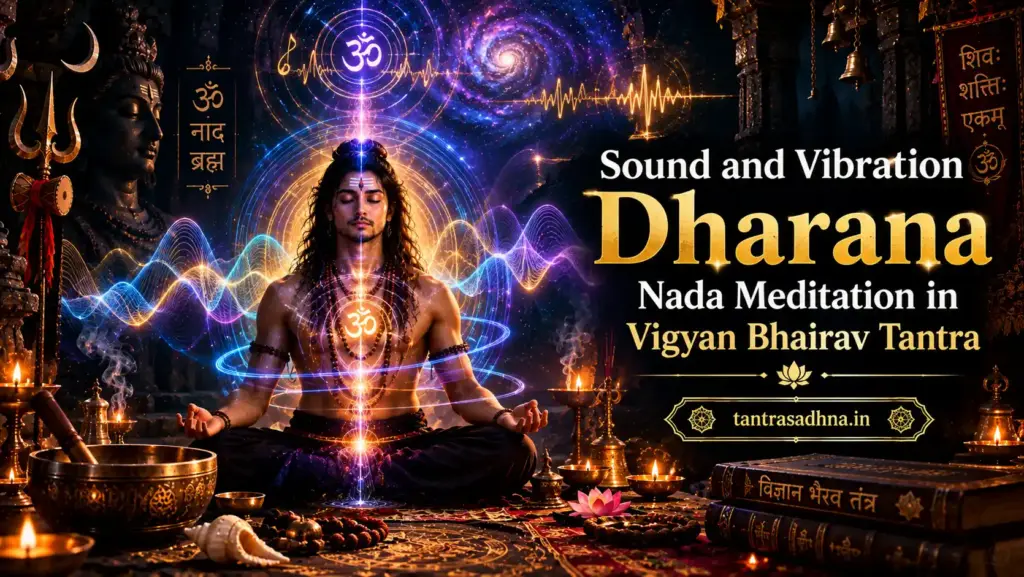
Sound and Vibration Dharana – Nada Meditation in Vigyan Bhairav Tantra
Among the 112 dharanas of Vigyan Bhairav Tantra, a distinct cluster uses sound — not as background accompaniment to meditation, but as the primary doorway into awareness itself. These are the sound and vibration dharanas, and they are among the most accessible techniques the text offers, because sound is always present and the capacity to listen requires no prior meditative training.
This guide covers the two main approaches in this family: the practice of chanting AUM and following its vibration inward, and the practice of listening to external sound until only the quality of listening remains. It also introduces the concept of nada — inner sound — as the tantric framework underlying both.
Sound Is Not Just Auditory
The starting point for understanding these dharanas is the tantric view of sound, which differs substantially from the ordinary understanding.
In Kashmir Shaivism and the broader Shaiva-Shakta tradition from which Vigyan Bhairav Tantra emerges, sound (shabda) is understood as one of the primary expressions of consciousness. The universe is understood to arise as vibration — a movement outward from silence — and what we perceive as audible sound is only the grossest, most surface expression of this vibratory nature. Below audible sound lies a subtler resonance; below that, subtler still; at the deepest level, what the tradition calls para vak or transcendent sound, which is indistinguishable from pure awareness itself.
This is the map underlying the sound dharanas. You begin with a gross sound — a chant, an external noise — and follow it inward through progressively subtler layers until the sound dissolves and only its source remains. That source, in the tantric understanding, is consciousness.
This framework belongs to the belief system of the Kashmir Shaiva tradition. Modern science has not confirmed or denied its metaphysical claims. What the practitioner can observe directly is what happens when attention follows sound inward with care and consistency — and that observation does not require prior philosophical commitment.
Practice One — Chanting AUM and Following the Vibration
This is among the most complete and widely practiced of the sound dharanas.
How to begin. Sit with spine upright, body relaxed. Take a few natural breaths to settle. Then inhale fully, and on the exhalation, produce the sound AUM — the three components A, U, and M flowing into one another, with the final M continuing as a hum that vibrates in the chest and head.
This is familiar territory to anyone who has attended a yoga class. What is less familiar is the instruction that follows in the tantric practice: do not simply repeat the chant mechanically. Instead, follow the vibration.
Following the vibration. As you produce the AUM, bring attention to where you feel the resonance in the body. The A typically resonates low in the chest and belly. The U tends to rise to the mid-chest and throat. The M — especially the extended hum — vibrates in the skull. Track this movement of resonance as the sound progresses. At the end of the exhalation, when the M has faded to nothing, there is a moment of silence. Rest in that silence before inhaling for the next repetition.
Over the course of the practice — ten to twenty minutes — something shifts. The gross audible sound becomes less important than what follows it: the silence that the sound reveals. Practitioners traditionally describe this silence not as mere absence of sound, but as the ground from which the sound arose and to which it returns. The instruction is to rest in that ground.
The distinction from ritual chanting. AUM appears across Hindu, Buddhist, and Jain traditions in ritual contexts — as a sacred syllable opening prayers and ceremonies. That use has its own value. The Vigyan Bhairav Tantra uses AUM differently: as a technique, not a ritual. The syllable is a vehicle for attention to travel inward. What matters is not the sanctity of the syllable but the quality of following.
Practice Two — Listening Until Only Awareness Remains
This dharana begins with external sound and moves inward through a different mechanism.
The practice. Sit in a natural environment where sound is present — a garden, a room near an open window, or simply an ordinary quiet interior where ambient sounds are audible. Close your eyes. Begin listening.
At first, you are hearing sounds — identifying them, labeling them, relating to them through thought. A bird, a car, the wind. This is the ordinary mode of perception. The practice asks you to move to a different mode: listening itself, without the labeling.
To do this, bring attention to the act of listening rather than to the sounds. Notice that listening is happening — and stay with the listening, not with any particular sound that arises within it. Sounds come and go. The listening continues.
Over time, attention deepens into the listening itself — a quality of open, receptive awareness that is not pointed at any particular sound but is available to all of them. This open quality, the tradition suggests, is not a means to something else. It is itself the awareness you are looking for.
The Concept of Nada — Inner Sound
Nada is the Sanskrit term for inner sound — a subtle resonance that, according to the tantric and yogic traditions, is audible in deep meditation to those who have stilled gross sensory and mental activity. It is described variously as a ringing, a hum, a high-pitched tone, or a vast ocean of sound — with the precise quality varying between practitioners and texts.
Working with nada is an advanced aspect of these dharanas. It is not something the practitioner generates or produces — it is understood as something that is already present and becomes perceptible as other noise (both external and internal) settles. If during the practice of either AUM chanting or deep listening you become aware of a subtle internal resonance, the instruction is to turn attention gently toward it and follow it — exactly as you would follow the vibration of AUM — inward.
Not all practitioners encounter nada in a recognizable form. Its absence does not indicate that the practice is not working. The gross-to-subtle movement of attention that the sound dharanas cultivate is valuable at every stage, whether or not nada becomes perceptible.
Choosing Between These Approaches
Practitioners sometimes ask which of the sound dharanas to use. A few guidelines:
Those who find pure silence difficult to inhabit and benefit from having a sound to follow will typically find the AUM practice easier to enter. Those who have a quieter baseline and find chanting effortful or artificially imposed tend to respond better to the pure listening practice. If you are unsure which approach suits you, see choose your meditation technique for a broader framework.
For how to structure sound practice alongside other dharanas, see how to practice Vigyan Bhairav Tantra.
A complement to the sound dharanas worth noting: the darkness meditation dharana uses the same principle of following a sensory quality inward until it opens into a ground of awareness — but through the sense of sight and darkness rather than sound. If the sound techniques resonate, the darkness technique may be a natural pairing.
Frequently Asked Questions
Do I need to chant AUM in a specific way — a particular pitch or volume? No. The pitch and volume are less important than the quality of following. Chant at a volume that feels natural and allows you to feel the resonance in the body. Extremes — very loud or barely audible — both tend to make the following quality harder to sustain.
What if I live somewhere noisy and can’t find quiet for the listening practice? Urban ambient sound is a valid field for the listening dharana. Traffic, voices, city noise — these are all sound. The practice is not about finding ideal sound but about changing the quality of listening. Some practitioners report that complex or unpredictable sound environments are actually effective training grounds because they offer so much for attention to release its grip on.
Is there a difference between the AUM dharana and mantra japa? Yes. Japa is repetition of a mantra as a devotional or ritual practice — the mantra is an object of devotion, and the repetition builds concentration. The AUM dharana uses the syllable as a vehicle for following vibration inward toward its source. The orientation of attention differs considerably, even if the outward form looks similar.
How long should a session last? Twenty to thirty minutes is a suitable sitting length for either practice. The listening practice in particular tends to require some time before the shift from “hearing sounds” to “resting in listening” becomes stable — shorter sessions may not allow enough time for that shift.
Can I combine these two practices in a single session? Yes. A natural sequence is to begin with AUM chanting for ten to fifteen minutes, allowing it to settle into silence, and then continue with the listening practice in that silence. The two support each other well.
How does sound dharana relate to the other 112 techniques? It belongs to a family of sense-based techniques that use one of the five senses as a doorway. For a full picture of how all the dharanas are organized, see the complete guide to the 112 dharanas.