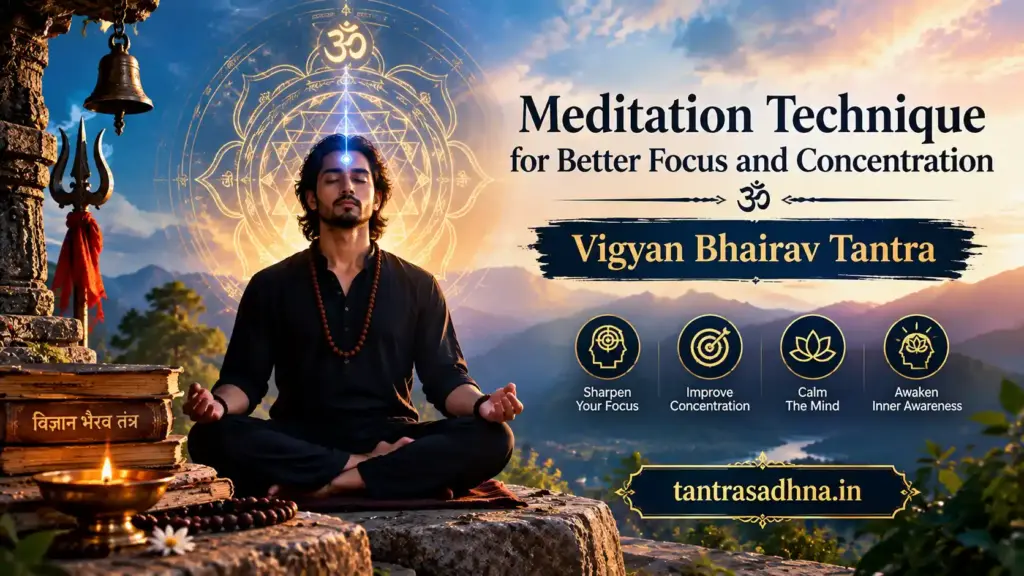
Meditation Technique for Better Focus and Concentration
The modern mind is under an unprecedented volume of demand. Notifications arrive continuously. Attention moves between tasks, screens, conversations, and background concerns throughout the day. Sustained focus on a single thing — what used to be considered ordinary — now feels like an achievement.
It is not surprising that improving focus is one of the most common reasons people seek meditation. And there is a genuine basis for this: regular meditation practice does appear to affect attentional capacity. But the mechanism is often different from what people expect, and the timeline is longer. Understanding both helps you build a practice that actually delivers, rather than one that disappoints after a few sessions.
The Vigyan Bhairav Tantra contains several techniques particularly suited to developing concentration and mental clarity. This article identifies which ones, explains why they work, and sets realistic expectations for outcomes. For a broader map of available techniques, see the guide to choosing your meditation technique.
The Tantric Understanding of Why Modern Minds Are Scattered
The VBT tradition did not anticipate smartphones, but its diagnosis of the scattered mind is structurally accurate. The mind becomes scattered when its attention is continuously distributed across external stimuli — when there is no experience of stillness and no counterweight to the outward pull of activity.
This is not a moral failing. The mind adapts to its conditions. When the conditions are continuous fragmented stimulation, the mind becomes skilled at fragmented attention. When the conditions include regular periods of sustained, single-pointed awareness, the mind develops that capacity instead. Meditation provides a daily counter-condition that gradually shifts the mind’s default mode.
Which VBT Techniques Support Focus
Not all VBT dharanas are equally suited for developing focus. Techniques that work with a specific, concrete focal point are more directly relevant than diffuse-awareness or gap-based techniques. Three are particularly suitable:
The Third Eye Dharana
The third eye dharana directs awareness to a point between and slightly above the eyebrows — known in various traditions as the ajna chakra or the seat of discriminative intelligence. This is one of the most traditional focus-development practices in the Indian contemplative tradition and appears in several forms across yoga and tantra.
Practitioners report that sustained practice with this technique develops a quality of concentration that feels less effortful over time — the attention learns to rest at this point with increasing ease and stability. Many practitioners also report a sense of increased mental clarity and sharpness in the hours after practice.
The technique is appropriate for beginners, though the experience of locating the exact focal point takes some practice.
The Navel Center Dharana
The navel center dharana places awareness at the navel — the manipura center, traditionally associated with will, clarity, and the fire of discernment. This is a grounding technique: it anchors awareness in a physical center of the body, which tends to produce a quality of steady, calm alertness rather than the sometimes-energizing quality of the third eye practice.
For practitioners who find that focus is undermined by tension or anxiety — who become scattered because they are stressed rather than simply distracted — this technique is often more suitable than the more activating third eye approach.
The Gap Between Thoughts — For Experienced Practitioners
The gap between thoughts meditation is one of the subtler techniques in the VBT and is most suitable for practitioners who already have some stability in their practice. It directs awareness to the natural pause that arises between one thought ending and the next beginning — a gap that is almost imperceptible to the untrained mind but becomes increasingly apparent with practice.
This technique is not recommended as a starting point for beginners. It requires pre-existing attentional stability to locate the gap reliably. Introduced too early, it tends to produce frustration. For practitioners with six months or more of regular practice, however, it is among the most powerful tools in the tradition for developing non-distracted awareness.
Realistic Outcome Framing
Improved focus is a natural effect of regular meditation practice. This is supported by the experience of long-term practitioners and is broadly consistent with how VBT practice is described in the tradition. However, the following qualifications are important:
The timeline is weeks to months, not sessions. After one session, most people feel some post-session clarity. But the persistent shift in baseline attentional capacity develops over months of consistent practice. People who commit to daily practice for three months and assess honestly at the end typically notice genuine change.
The mechanism is indirect. Meditation does not train focus like a muscle. It establishes a baseline experience of stillness that gradually recalibrates the mind’s default mode. Improved focus in daily life is a side effect of the practice, not its direct product.
Consistency matters more than duration. Ten minutes daily develops focus more reliably than occasional long sessions.
Using VBT Practice as a Pre-Work Focus Ritual
A five-to-ten minute session using the third eye or navel center dharana before demanding work can function as an attentional reset — stepping out of the fragmented mode of the morning and into a more collected state before engaging with the task. This is a supplementary use of the technique, not a substitute for a regular practice. It tends to work best for practitioners who can already settle into the technique quickly.
Consistent timing and the same seated posture reinforce the ritual’s effect. Over time, the posture itself can begin to function as a cue for the focused state.
Medical Caveat
Meditation can support attentional capacity when scattered focus stems from lifestyle conditions — overstimulation, stress, lack of stillness. It is not a treatment for ADHD or other neurological conditions. If you suspect an attention condition, consult a qualified healthcare professional. Meditation can complement treatment, but it is not a substitute.
Personalized Guidance
Whether you need grounding stability or energizing clarity — whether you are a beginner or have prior practice — the right technique varies from person to person. A one-to-one consultation can identify the right technique, correct errors in practice, and build a realistic plan. For the full range of options, see the guide to the 112 dharanas.
Frequently Asked Questions
Q: How many minutes per day of meditation is needed to see improvement in focus? Even 10 minutes of daily, consistent practice shows meaningful results over eight to twelve weeks for most practitioners. The quality of the session — whether you are genuinely engaging with the technique rather than drifting through it — matters as much as the duration.
Q: Is it better to meditate before work or in the morning? Both serve different purposes. Morning is optimal for building the practice — the mind is alert before the day’s stimulation begins. A brief pre-work session (5–10 min) offers a practical attentional reset. The two can coexist.
Q: I get more distracted during meditation than during normal work. Is that normal? Yes. Meditation makes the mind’s ordinary activity more visible, not less active. What feels like increased distraction is usually increased awareness of distraction. This awareness is itself the beginning of the capacity to choose where attention goes.
Q: I’ve meditated for two months and my focus at work hasn’t changed. What am I doing wrong? A few possibilities: sessions may be irregular (inconsistency is the most common issue); the technique may not be well-matched to your constitution; the sessions may be drifting rather than genuinely engaging with the technique. A consultation can often identify the specific factor quickly.
Q: Should I practice with eyes open or closed for focus? Eyes closed is the default for most VBT dharanas — it reduces external distraction and makes the internal focal point easier to locate. Some practitioners find a soft half-open gaze works well for the third eye practice. Experiment to find what supports your own sitting.