Meditation on the Spine – Sushumna Energy Dharana (Vigyan Bhairav Tantra)
Among the body-center techniques in the 112 dharanas of Vigyan Bhairav Tantra, the instruction to rest awareness along the spine stands out for its combination of anatomical directness and subtle depth. The spine is not a subtle or imagined structure — it is the literal axis of the human body, the most present and recognizable interior landmark most people have. That is precisely why this dharana works.
What the Text Instructs
The relevant verses in the Vigyan Bhairav Tantra direct the practitioner to place awareness within the central column of the body — from the base of the spine upward through the length of the back to the crown of the head. In some readings, the instruction is a steady, ascending sweep of attention from base to crown; in others, the instruction is simply to rest in the sensation of the spinal column as it is, without movement. Both readings are valid approaches, and both are covered below.
The bare instruction does not prescribe visualization of lights, colors, or energetic phenomena. Those elements belong to other frameworks. The VBT practice is a placement of awareness — sustained, gentle, interior.
The Tantric Understanding of the Sushumna
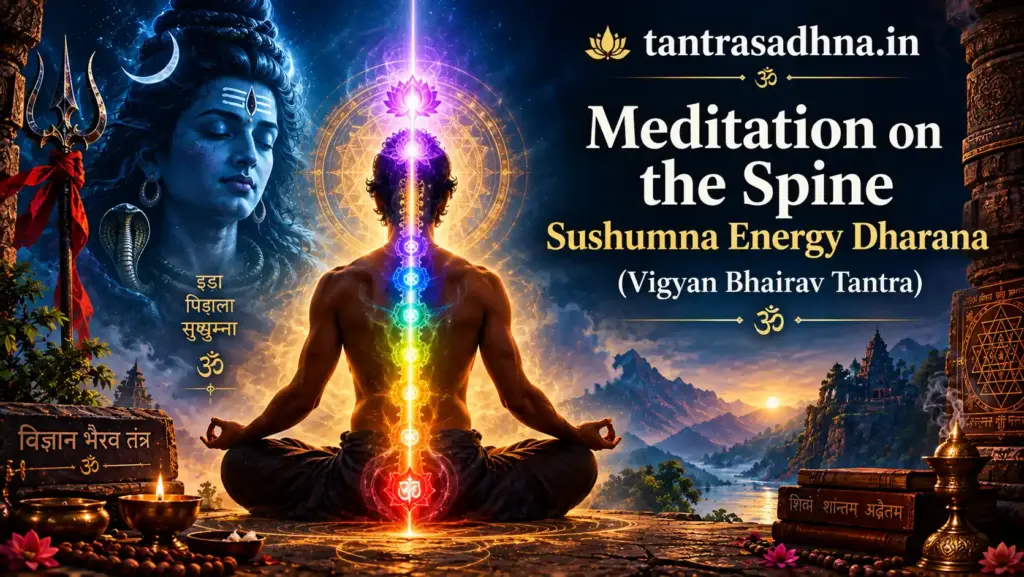
In the framework of Kashmir Shaivism and classical Indian yoga, the body is understood to have a subtle anatomy alongside its physical one. Within this model, the sushumna nadi — the central channel — runs along the line of the spinal column, from the base (the muladhara region, at the base of the pelvis) to the crown (sahasrara). Flanking it on either side are two other channels: ida (traditionally associated with lunar, cooling, right-brain qualities) and pingala (solar, warming, left-brain qualities). These two channels are understood to cross repeatedly as they ascend, meeting at each of the major energy centers (chakras) along the spine.
Ordinarily, in the tantric understanding, prana (life energy) moves through ida and pingala — the two side channels — rather than through the central sushumna. The sushumna is described as the path of awakening: the channel through which energy rises when the meditating mind achieves a particular quality of balanced stillness that allows both side channels to converge into the center.
This is the traditional framing. It should be stated plainly: the subtle body — its channels, centers, and the movement of prana through them — belongs to a philosophical and experiential tradition, not to anatomical science. Modern physiology does not confirm the existence of nadis as physical structures. A practitioner does not need to hold a belief in the subtle body for this dharana to be a valid and effective practice. What is needed is the capacity to rest awareness along the interior line of the spine.
The Practice: Two Approaches
Approach One — Sweeping Awareness
Sit with the spine upright but not rigid. Close the eyes. Spend two or three minutes letting ordinary surface agitation settle with natural breath.
Then bring attention to the base of the spine — the area at the very base of the pelvis and sacrum. Rest there briefly, feeling the weight and solidity of the base. Then allow attention to begin a slow, unhurried ascent: up through the lumbar (lower back) region, continuing through the thoracic (middle back), through the cervical spine at the back of the neck, and finally arriving at the crown of the head. Pause at the crown. Then allow attention to descend again, just as slowly.
The movement is of awareness — not of breath, not of a visualized light or ball of energy. Simply the movement of where you are paying attention. A single upward or downward sweep might take two to three minutes. Settle into a pace that does not feel hurried.
Approach Two — Resting in the Column
Rather than sweeping, this approach involves resting awareness in the sensation of the spinal column as a whole — the entire vertical interior line of the back, present simultaneously.
To begin: sit as above. After settling, bring attention to the physical sensation of the spine — the sense of the body’s central pillar, from base to crown. It is available as a felt sense, not a visual image. Once you locate that sense, simply rest there. Allow the awareness to be with the entire length of the spine without moving up or down.
This second approach tends to develop the quality of interior centeredness more directly and is often preferred by practitioners who already have some foundation in body-center techniques such as the navel center dharana.
Why the Spine Works as an Object of Attention
The spine is the literal axis of the body. Every movement of the limbs is organized around it, and the entire nervous system — including the brain — is an elaboration of the spinal cord. Directing sustained attention to this axis has a natural organizing and centering effect on experience. Practically, awareness of the spine tends to produce an almost automatic correction of posture. The body straightens; that improved alignment then supports a more alert, settled quality of mind, deepening the meditation in turn.
Energy Visualization — Optional and Secondary
Some teachers work with visualization alongside spinal meditation: a column of light ascending the spine, chakras as colored wheels, energy as heat or current. The Vigyan Bhairav Tantra does not prescribe any of this. Visualization belongs to other frameworks; it is not in the VBT’s instruction for this dharana. If visual imagery arises spontaneously, note it without elaborating it. If it does not, the practice is complete without it. Start with the bare awareness instruction. Visualization can be revisited later if it arises organically.
What Practitioners Report
Practitioners who work consistently with this dharana over weeks and months commonly report:
Postural straightening. Almost universally described in early practice. The body seems to find a more natural upright alignment when awareness rests in the spine.
Warmth along the back. A mild warmth or gentle internal sensation along the line of the spine, reported particularly in the thoracic region and at the base of the skull.
Increased alertness. A quality of wakeful, gathered attention that differs from ordinary mental alertness — clearer but also more still.
A sense of interior axis. A felt sense of being organized around a central line, which many practitioners find carries into daily life as a quality of psychological steadiness.
These are descriptive reports of practitioner experience, not guaranteed outcomes. Individual experiences vary, and no particular experience should be treated as the goal or criterion of success.
Working Safely with Energy Sensations
Some practitioners, particularly those who have been working with any form of yoga, pranayama, or energy practice, find that spinal awareness techniques can produce intense sensations — heat, pressure, pulsing, or strong emotional material arising without apparent cause.
If this occurs:
Do not force the experience or attempt to intensify it. The approach in this dharana is one of soft, receptive awareness — not active direction of energy.
If sensations become overwhelming, stop the practice, open the eyes, breathe naturally, and ground attention in the physical surroundings. Strong unsought energy experiences that arise consistently in a practice are a sign to slow down, reduce session length, and — particularly if experiences are distressing or disorienting — to seek guidance from a qualified teacher.
This is not a routine risk for most practitioners working with ordinary seated attention. It is a caution for those who find this technique unexpectedly intense.
Companion Practices
For the upper-body complement to this dharana — working with the concentration of energy at the ajna center — see the third eye dharana. For the lower-body complement, working with the body’s gravitational center, see the navel center dharana. If you are working through all the dharanas systematically and want to understand how to structure this practice alongside others, how to practice Vigyan Bhairav Tantra covers session structure in detail. For the full context of where this technique sits within the 112, see the complete dharana guide.
If you are new to these practices and unsure whether working with a guide is appropriate for you, why a guide for tantra addresses this question directly.
Frequently Asked Questions
Is this the same as kundalini yoga? There is a relationship, but they are not identical. Kundalini yoga is a structured system with specific kriyas (sequences), breath practices, mantras, and a defined framework for working with the spinal energy. This dharana is a much simpler practice: resting awareness in the spine. The two share territory but differ in structure, intensity, and context. If you are drawn to kundalini yoga, working with a qualified teacher in that tradition is recommended.
Do I need to imagine a light or energy moving up my spine? No. Visualization of light or energy is not part of the VBT instruction for this dharana. It is optional, belongs to other frameworks, and is best left aside until bare awareness practice has established itself over weeks.
What if I can’t feel my spine during meditation? This is common in the early stages. The felt sense of the interior of the body — called interoception — is a skill that develops with practice. Begin by placing attention at the back of the waist where the physical sensation of the lumbar curve is usually clearest. From there, expand the felt sense gradually upward and downward. Over weeks, the whole spinal column becomes more easily accessible to interior attention.
How long should each session be? Twenty to thirty minutes is appropriate for most practitioners. One complete ascending-and-descending sweep of attention typically takes five to eight minutes, depending on pace. A session might include three to four full passes, or simply an extended resting in the central column after an initial orienting sweep.
Can I practice this while lying down? The sitting posture is strongly preferred because it aligns the spine vertically and maintains the physical axis that the practice works with. Lying down flattens and distributes the spine, which makes the felt sense of the central column less distinct. It is also easier to fall asleep lying down, which ends the practice. Sitting is recommended.
How does this relate to the other 112 techniques? This dharana belongs to the family of body-center and energy-channel practices within the Vigyan Bhairav Tantra. For a complete account of how the 112 techniques are organized and how this one fits among them, see the full guide to the 112 dharanas.