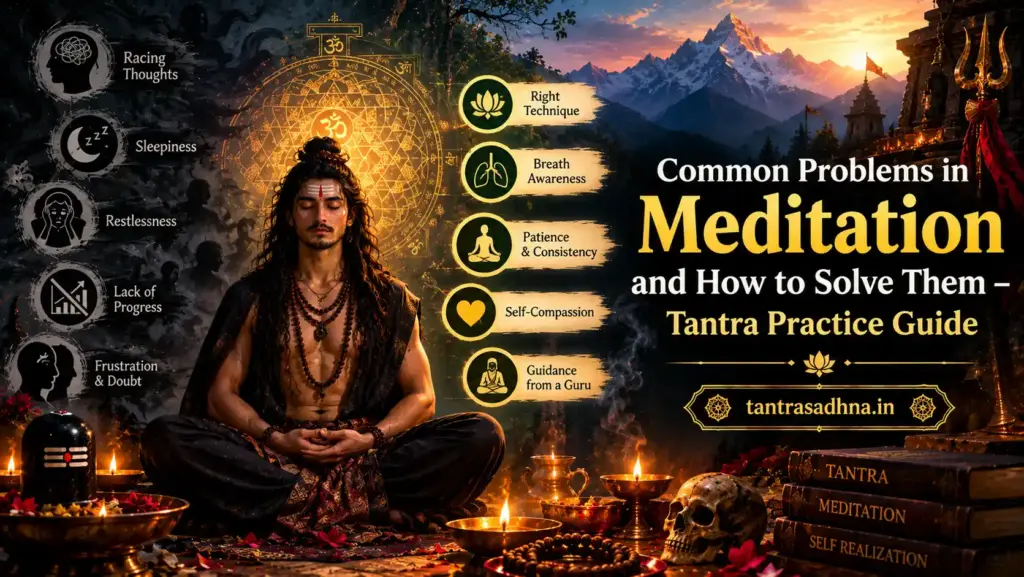
Common Problems in Meditation and How to Solve Them
If you sit down to meditate and things go smoothly every session, you are either very experienced or you haven’t been sitting long enough. Obstacles in meditation are not signs of failure — they are a normal and predictable part of the process. The Vigyan Bhairav Tantra tradition does not ask you to suppress or overcome these obstacles through willpower. It offers a subtler approach: work with what is arising, not against it.
This guide covers the five most common problems practitioners encounter, along with practical adjustments rooted in VBT principles. For a full overview of how to structure your practice, see the complete VBT practice guide.
Problem 1: The Restless or Racing Mind
This is by far the most common complaint: “My mind won’t stop.” Thoughts crowd in, plans surface, memories appear, mental commentary runs nonstop.
Why it happens: The mind is conditioned to constant activity. When you remove external stimulation by sitting still and closing your eyes, the backlog of mental activity becomes more visible — not more active. You are not creating more thought; you are simply noticing what was always there.
What not to do: Do not fight the thoughts. Trying to force the mind to stop is like trying to smooth water by pressing your palm against it — you create more turbulence.
What to do: The VBT approach is to become the witness of the restlessness rather than a participant in it. Notice that you are aware of the racing thoughts — that awareness is already separate from the thoughts themselves. Gently return attention to the breath, using a simple breath dharana: observe the natural movement of breath without controlling it. The point is not to stop the mind but to stop fighting the mind. The restlessness tends to settle on its own when it is not reinforced by resistance.
Problem 2: Sleepiness and Drowsiness
You sit down, begin to relax, and within minutes you are nodding off. This is extremely common, especially among people who are sleep-deprived or who practice in the evening.
Why it happens: In classical terms, sleep is associated with tamas — the quality of heaviness and inertia. When the body relaxes deeply, especially if tired, consciousness dims. If your body associates stillness with sleep, it may follow that pattern even while seated.
What to do:
- Check your timing. Immediately after waking (before breakfast, before screens) is traditionally recommended — the mind is alert but not yet agitated. The best time for tantra meditation depends on your constitution, but early morning tends to support alertness.
- Sit upright. Slouching invites drowsiness. Good meditation posture keeps the body alert without discomfort.
- Open your eyes briefly. If sleep pulls you down, open your eyes softly for 10–15 seconds without engaging visually, then close them again. This often breaks the drowsiness without disrupting the session.
Problem 3: Physical Discomfort
Back pain, knee pain, numbness in the legs — physical discomfort is real and should not be dismissed as “just the ego resisting.”
The distinction that matters: There is a difference between the mild discomfort of an unused posture (which typically passes after a few weeks of regular sitting) and genuine pain that signals a risk of injury. The first is workable; the second is a signal to adjust.
What to do: Adjust your posture rather than white-knuckling through pain. Use a cushion, a folded blanket, or a chair if needed. Sitting in a chair with feet flat on the floor is a perfectly valid meditation posture — it is not a compromise. See the full meditation posture guide for options. Once the posture is stable and not actively causing pain, mild sensations of heaviness or tingling are generally workable.
Problem 4: Nothing Is Happening / I Feel Nothing
“I sit for 20 minutes and I don’t feel anything. Am I doing it wrong?”
The expectation problem: Most people begin meditation with an implicit expectation that something dramatic will happen — a feeling of bliss, a burst of clarity, a sense of deep stillness. When that doesn’t arrive, the session feels like a failure. But this expectation itself is one of the primary obstacles.
What “subtle” actually means: In the early stages, the effects of meditation are genuinely subtle — a slight reduction in background tension, a moment of quiet between two thoughts. These are real, but easy to miss when scanning for something dramatic.
What to do: Lower the bar for what counts as a “good session.” A session in which you simply sat, kept returning to the technique, and finished without leaving early — that is a successful session. Effects accumulate over weeks, not within individual sessions.
Problem 5: Strange Sensations or Emotions Arising
Some practitioners encounter unexpected experiences: tingling in the body, pressure in the head, sudden waves of emotion, sadness arising without cause, or brief flashes of imagery.
Don’t panic, don’t force: These experiences are reported by many long-term meditators and are generally understood in the VBT tradition as the natural result of turning awareness inward — suppressed or stored material surfaces when the habitual outward activity of the mind pauses. This is not a crisis.
What to do: Note the experience without trying to amplify or suppress it. Continue with the technique. If a wave of emotion arises, you do not need to analyze its origin — simply observe it as a sensation, the same way you observe breath.
When to stop: If an experience feels genuinely overwhelming, or if strong emotional states persist well beyond the meditation session, stop the session and rest. This is one of the reasons having a guide for tantra practice is valuable — a teacher can help you interpret and contextualize unusual experiences rather than leaving you to navigate them alone.
The Underlying Principle
Most meditation problems share a common root: resistance. The VBT approach is consistently non-combative — witness what arises, return gently to the technique, trust the process. The 112 dharanas exist in such variety precisely because different obstacles respond to different techniques. If one approach isn’t working, another may suit your temperament better.
Frequently Asked Questions
Q: How long does it take for the restless mind to settle? Most practitioners report that within 3–4 weeks of daily sitting, the initial restlessness becomes more manageable. There is no fixed timeline — consistency matters more than speed.
Q: Is it normal to feel more anxious or emotional in the first few weeks? It can happen. When habitual suppression is interrupted by stillness, what was suppressed can surface. This typically passes. If it feels severe or disruptive, reduce session length and consider seeking guidance.
Q: Should I meditate through physical pain? Not through sharp or injury-level pain. Mild discomfort from an unused posture is workable and typically fades. Actual pain that worsens — adjust your posture or use a chair.
Q: What if I fall asleep every single session? Shift your practice to immediately after waking, before eating. Keep sessions shorter — 10 minutes of alert sitting is more useful than 20 minutes drifting in and out of sleep.
Q: Is “nothing happening” a sign I should switch techniques? Not after a few sessions. The sense that nothing is happening is extremely common in the first weeks. Give any technique a minimum of two to three consistent weeks before evaluating.
Q: Can I meditate if I have anxiety? Many people with anxiety find meditation helpful, but technique selection matters. Start with breath-based dharanas. See the guidance on VBT practice and consult a qualified teacher if navigating significant anxiety.