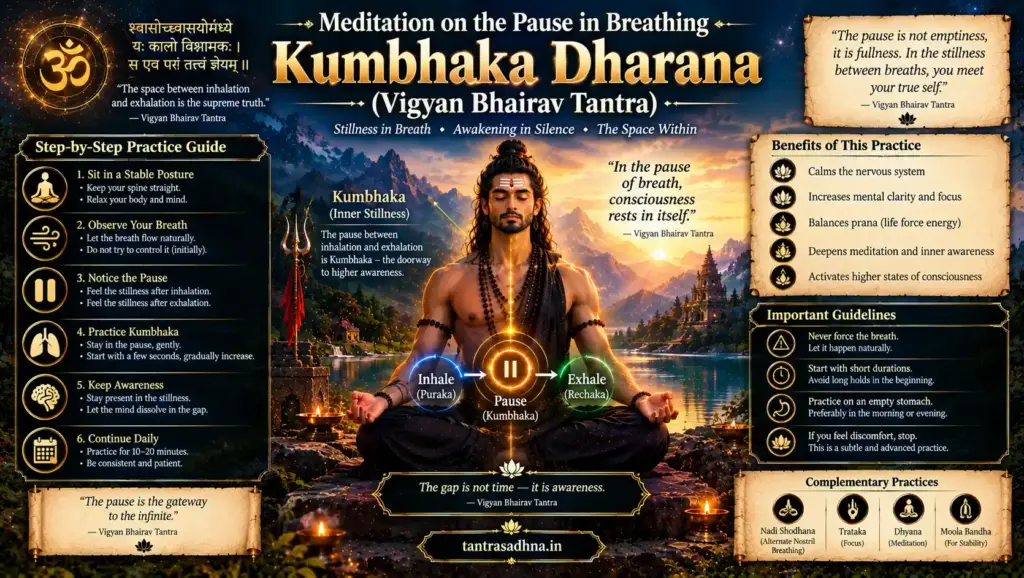
Meditation on the Pause in Breathing – Kumbhaka Dharana (Vigyan Bhairav Tantra)
In the sequence of breath techniques that opens the Vigyan Bhairav Tantra, the second method moves from catching the turning point of breath to resting in the natural pause that follows it. Where the breath-between-breaths dharana asks for a quick, precise noticing of the moment of reversal, this dharana asks something slightly different: a quality of restful, open presence in the brief stillness that the breath itself offers, uninvited, after every complete inhalation and every complete exhalation.
It is one of the quietest practices in the entire collection, and one of the most frequently misread.
The Instruction
The verse (verse 3 in many enumerations, sometimes grouped with verse 2) can be rendered as:
“Or, when breath is retained after full inhalation or after full exhalation — in that stopping, the universal energy.”
The Sanskrit term kumbhaka is traditionally used in yoga and pranayama for deliberate breath retention — holding the breath in after filling the lungs (antara kumbhaka) or holding it out after emptying them (bahya kumbhaka). Seeing this word can lead practitioners to assume the dharana requires forceful pranayama techniques. It does not.
Shiva is pointing to something that already happens without effort: after you have fully inhaled, before the next exhalation begins, there is a natural moment of fullness and stillness. After you have fully exhaled, before the next inhalation begins, there is a natural moment of emptiness and stillness. These moments are not manufactured. They are pauses that breathing creates on its own.
The practice is to rest awareness in those pauses — with alertness, without grasping.
Natural Pause vs. Forced Retention
This distinction is not a minor technical point. It defines what the practice actually is.
Forced kumbhaka — the deliberate holding of breath used in classical pranayama — works with muscular and diaphragmatic control. The practitioner actively closes the throat or contracts the abdomen to extend the pause beyond its natural duration. This produces different physiological effects and carries genuine risks if practiced without proper guidance, particularly for people with cardiovascular or respiratory conditions.
The kumbhaka dharana of the Vigyan Bhairav Tantra is not this. The breath is not held. It simply completes — and in that completion, there is a natural interval before the next breath begins. That interval is what the practice works with. The lungs are full and quiet, or empty and quiet. The practitioner’s only task is to be present there, without forcing, without prolonging, without moving into the next breath prematurely.
If you find yourself straining, turning red, or feeling air-hunger within seconds, you have imported the pranayama version of kumbhaka into a practice that does not require it. Relax the effort completely and simply allow the breath to find its own natural pause.
The Tantric Understanding of the Pause as Doorway
In Kashmir Shaiva understanding, the pauses of breath hold special significance because they represent a point at which the ordinary restlessness of both body and mind is naturally — not forcibly — suspended. The in-breath and out-breath are movements; the pause is a moment of non-movement. The tradition holds that it is in non-movement that the awareness which underlies all movement can be tasted most directly.
The image sometimes used is that of a flame in a room with no wind. When the breath moves, the flame (awareness) flickers with it. In the pause, the flame stands perfectly still — and in that stillness, its true nature is visible in a way it is not when it is flickering.
Whether or not one accepts this metaphysical framework, there is something practically useful about the pause: it is a reliable interruption in the ordinary continuity of sensorimotor activity, brief enough to occur dozens of times per minute, frequent enough to make it an accessible object of practice throughout an entire sitting.
Practice Instructions
Settle into a comfortable seated position. Spend several minutes simply observing natural breath without any adjustment.
Step one — finding the pauses. Without changing the breath’s rhythm, begin to notice what happens at the very end of a full inhalation. The lungs have expanded. The breath is complete. For a fraction of a second, nothing has yet moved toward exhalation. Rest your attention there — not in the breath, but in the quiet at the edge of the full breath.
Allow the exhalation to begin naturally. Follow it to its end. At the very bottom of the exhalation, notice the same quality of quiet: the body is empty, no new breath has yet arrived. Rest attention there.
Step two — the quality of presence. The attention you bring to the pause should be receptive and open, not effortful. You are not trying to freeze time or extend the pause. You are simply present at a point the breath naturally reaches. Think less of “holding” and more of “arriving and staying briefly.”
Step three — continuity. Your practice during a sitting is to remain alert through many breath cycles, consistently arriving at both pauses — the pause of fullness and the pause of emptiness — without losing attention in the movement between them.
A sitting of fifteen to twenty-five minutes is appropriate for most practitioners. Daily practice is more valuable than occasional long sessions.
Finding and Extending Awareness Without Force
“Extending” the pause is not about prolonging the breath hold. It is about deepening the quality of presence within the pause as it naturally occurs.
One useful way to approach this: on days when the pause feels too brief to really settle into, try slightly deepening — not slowing — the breath. A full, unhurried inhalation produces a slightly more spacious natural pause at the top. A complete, relaxed exhalation produces a slightly more spacious natural pause at the bottom. This is not forced retention; it is simply breathing fully, which most people rarely do in ordinary life.
As weeks of practice accumulate, most practitioners report that the pauses become more perceptible — not because they are objectively longer, but because attention has become more refined at arriving at them.
What Practitioners Typically Report
In the early weeks, many people barely notice the pauses at all. The mind tends to skip over them in anticipation of the next breath. This is normal.
With consistent practice, practitioners commonly report a growing sense of spaciousness around the pause, particularly the pause at the end of exhalation. The pause after exhale is traditionally considered the more significant of the two in many lineages, because the body is empty and cannot sustain the ordinary grip of ego-driven thought as easily. Some describe it as a momentary sense of dissolving into something larger than the individual. Such descriptions belong to spiritual tradition and personal report — they are not guaranteed, and they vary considerably from person to person.
What most practitioners do reliably describe, regardless of interpretive framework, is a noticeable quieting of mental activity during the periods they spend attending to the pauses.
Frequently Asked Questions
Is this practice safe if I have asthma or a respiratory condition? Because this dharana works with natural, unforced pauses only, it is generally far safer than pranayama breath-retention techniques. However, if you have any respiratory or cardiovascular condition, it is wise to consult a healthcare professional before beginning any breath-based meditation practice. Do not force any retention.
What is the difference between this dharana and the breath-between-breaths technique? The breath-between-breaths dharana works with the instantaneous moment of turning — the fraction of a second where in-breath becomes out-breath. This dharana works with the natural pause of completeness that follows a full inhalation or exhalation — a slightly more settled, restful quality of attention. They are companion practices and suit different temperaments.
Should I do both pauses — after inhale and after exhale — or focus on one? The instruction covers both. Begin by noticing both in each breath cycle. Over time, you may find that one feels more natural or fruitful — this is a normal individual difference and not a problem.
Is kumbhaka in pranayama the same as this dharana? No. Classical kumbhaka in pranayama is deliberate breath retention, often with muscular locks (bandhas). The kumbhaka referred to in this dharana is the natural pause that breathing produces on its own. Forcing retention here would change the practice entirely.
How long until I notice something? This varies considerably. Some practitioners begin to sense the quality of the pause clearly within days; others take several weeks of regular practice. The tradition recommends at least forty days of consistent daily practice before drawing conclusions about a technique’s suitability for you.
Can I practice this alongside a pranayama routine? Most teachers in this lineage recommend keeping the dharana practice and a pranayama routine in separate sessions, since mixing breath control with breath observation can blur the quality of attention required for each. See how to practice Vigyan Bhairav Tantra meditation for general guidance on structuring your practice.