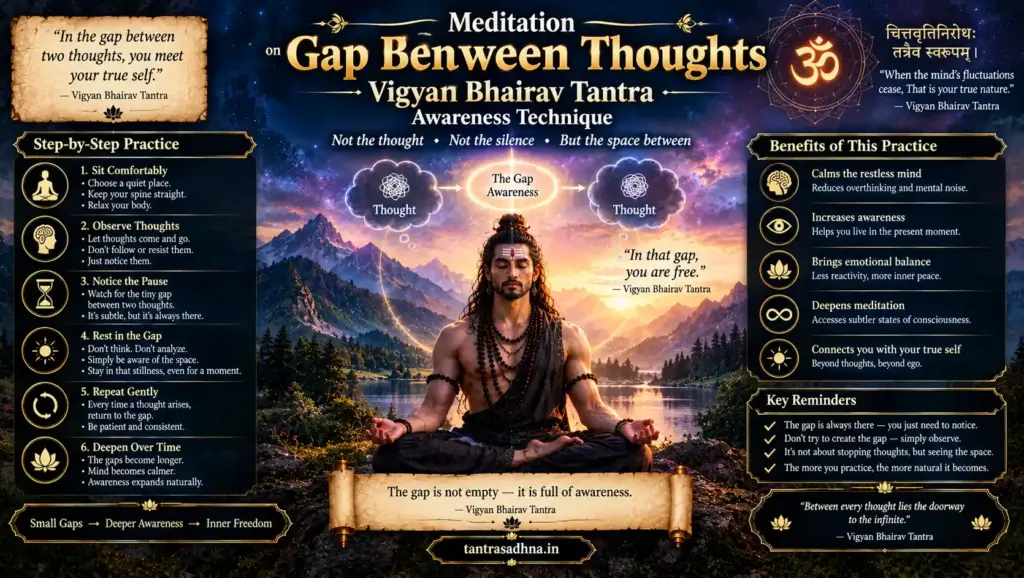
Meditation on the Gap Between Thoughts – Vigyan Bhairav Tantra Awareness Technique
Among all the 112 meditation techniques of Vigyan Bhairav Tantra, the awareness and void dharanas stand apart. They do not offer the mind an object to focus on — no breath, no body center, no mantra, no image. Instead, they turn attention toward the nature of awareness itself. The gap-between-thoughts dharana is the clearest example of this category.
The instruction is deceptively simple: notice the space that already exists between one thought and the next.
What the Text Points To
The Vigyan Bhairav Tantra contains a verse (placed in various positions depending on the translator, but commonly in the fifties or sixties in the sequence of 112) that directs the practitioner to observe the gap or interval between thoughts — the empty interval that separates one mental event from the next.
The verse points to something real and verifiable: thoughts do not actually form a seamless, unbroken stream. Between any two thoughts there is a brief interval — a space — that is itself free of thought content. In ordinary waking consciousness this interval goes completely unnoticed because the next thought arrives quickly enough to create the illusion of continuity. But with sustained attention, the gap becomes perceptible.
What the Vigyan Bhairav Tantra suggests is this: the gap is not an absence of consciousness. It is where consciousness shows itself in its natural state — not consciousness of something, but awareness as it is when no particular content is claiming attention.
Why the Gap Matters in the Tantric Understanding
The foundational premise of Kashmir Shaivism — the philosophical framework behind the VBT — is that the nature of reality is pure awareness (chit, or shiva-consciousness) that appears to fragment into individual minds and the objects they perceive. What prevents us from recognizing this is precisely the unbroken flow of thought, identity-maintenance, desire, and reactivity that fills waking consciousness from moment to moment.
The gap between thoughts is understood, from this perspective, as a naturally occurring window in which that unbroken flow is temporarily absent. In that window, awareness continues — but it is not occupied with any content. The tradition suggests that even a brief, clear recognition of this gap-awareness carries within it an unmistakable quality: it is open, spacious, and free of the sense of being a separate, bounded self.
This is the highest claim of the dharana, and it belongs to the metaphysical tradition rather than to empirical study. What can be said with confidence is that the practice of attending to the gap between thoughts tends, over time, to produce a notable shift in the relationship between a practitioner and their own mind — less identification with the content, more recognition of the space in which it arises.
How to Notice the Gap — Not Create It
This is where many practitioners misunderstand the dharana. The instruction is to notice a gap that already exists, not to manufacture silence by suppressing or stopping thoughts.
Trying to stop thoughts to create a gap is counterproductive in two ways. First, the effort to stop thought is itself a thought — and a fairly intense one — which only adds to mental activity. Second, even if you could momentarily blank the mind through force, what you would experience is a strained absence, not the natural open quality that the gap already has.
The practice instead looks like this: you allow thinking to continue naturally, but you begin to watch for the brief moment when one thought has ended and the next has not yet begun. You are not watching the thoughts themselves — you are watching for the pause between them.
A useful analogy: imagine watching cars pass on a road. Most of the time, you focus on the cars. This practice asks you to watch for the brief spaces between cars — the moments when the road is empty. The cars have not stopped; you have simply changed what you attend to.
Practice Instructions
Sit comfortably with eyes closed. Spend five minutes simply observing the mind without attempting to influence it. Notice thoughts arising and passing. Do not follow them; do not push them away. Simply observe.
Then gently shift the quality of attention. Rather than watching what each thought says, watch for the moment when a thought ends. As a thought completes — as the mental sentence finishes, or the image fades — notice whether awareness registers the space before the next thought begins.
Do not wait anxiously or expectantly. Anxious waiting is itself a thought that fills the gap. Instead, remain open and receptive. Think of your attention as resting lightly on the edge of thoughts, ready to notice the space when it appears.
When you notice you have become absorbed in a thought — following its content, building on it, reacting to it — gently return. The moment of returning is not failure; it is the core practice. Each return deepens the skill of recognizing when attention has been claimed by content versus resting in the space around content.
A sitting of twenty to thirty minutes is appropriate. Longer sessions are not necessarily more useful until stability has developed over several weeks.
The Role of Witnessing Versus Suppressing Thought
This distinction is central to the practice. Witnessing means observing thought from a position of slight distance — aware that a thought is occurring without being fully immersed in it. Suppressing means actively refusing to let thoughts arise, pushing them down, or judging them as problems to be eliminated.
Witnessing allows the gap to become visible. Suppression never will, because the effort of suppression fills exactly the space it is trying to clear.
In practice, the witnessing position can be cultivated by asking, each time you notice you are thinking: “Who is aware of this thought?” The question is not rhetorical. It redirects attention from the thought’s content back to the awareness in which the thought is appearing. From that position, the boundaries of thoughts — including the spaces between them — become more perceptible.
Common Confusion
The gap feels like blankness. Early in practice, the gap may feel like nothing — a dull flatness that seems unworthy of attention. This is partly because the mind is expecting a dramatic experience and is not yet trained to recognize the quality of clear, open awareness. Continue attending. The quality of the gap typically becomes more vivid over weeks of practice.
Thoughts seem to speed up. When you first begin watching for the space between thoughts, the mind often produces more thoughts, seemingly faster. This is a well-documented phenomenon in meditation generally — you have not produced more thoughts; you have simply started noticing thoughts you were previously ignoring. It settles.
Is this suitable for beginners? The gap-between-thoughts dharana is traditionally considered more accessible to experienced meditators because it requires a relatively stable attention base. Beginners often find it more useful to start with a breath technique — such as the breath-between-breaths dharana — where the gap in the breath offers the same principle (resting in a natural interval of stillness) but with a more concrete anchor. After several weeks of breath practice, the gap-between-thoughts technique tends to become much more accessible.
That said, there is value in introducing the principle to any practitioner, even a beginner. Simply noticing that gaps exist — that the mind is not actually a seamless wall of thought — can itself shift one’s relationship with mental activity.
What Practitioners Report Over Time
Practitioners who sustain this dharana across months commonly describe a growing sense of spaciousness around mental activity. Thoughts continue — but they are experienced as arising in something rather than being everything. This shift in relationship to thought is reported across many meditative traditions, though they describe it with different vocabularies.
The tantric tradition regards this shift as a direct experiential recognition of the nature of consciousness — not something added to experience, but a clearing away of the habitual overlay that conceals what was already present. These are experiential claims of a spiritual lineage, not medical or psychological diagnoses, and individual experience varies substantially.
What is consistent in practitioner reports, regardless of interpretive framework, is an increased capacity for a pause between stimulus and response in daily life — what some describe as greater equanimity, and others describe simply as less reactivity.
Choosing This Technique
If you are unsure whether this dharana suits you, or you want to compare it to other approaches, the technique finder can help you match a method to your temperament and experience level.
Frequently Asked Questions
Do I need to be an experienced meditator to try this? Some prior meditation experience helps significantly, because this technique requires stable enough attention to observe the mind without becoming absorbed in it. However, even a complete beginner can be introduced to the principle of noticing the gap — it simply may not deepen fully until some foundational attentional stability has been developed, ideally through a simpler technique first.
Is this practice about thinking less or becoming thoughtless? Neither, exactly. The practice is about recognizing the space in which thoughts arise — noticing that you are not your thoughts. Thoughts may or may not decrease; that is not the measure of success. What changes is the relationship to thinking.
How is this related to the breath-between-breaths dharana? They share the same structural principle: noticing a natural gap in an otherwise continuous process. In one case the process is breathing; in the other it is thinking. Practitioners who find one accessible often find the other accessible too. See the breath-between-breaths dharana for the companion practice.
Can I accidentally go into a blankness or dissociation? Genuine witnessing awareness is alert and present, not vacant. If you find yourself in a dull, foggy blankness, the quality of attention has slipped. Open your eyes briefly, take a few deliberate breaths, and begin again with clearer intention. Dissociation and meditative clarity are phenomenologically different — clarity has a quality of alertness that dissociation lacks.
How long should I practice before expecting to notice the gap? Most practitioners begin to notice the gaps — at least occasionally — within two to four weeks of regular daily practice. What develops over longer periods is the ability to rest in the gap more stably and to carry the quality of space-awareness into daily life.
Is this related to the concept of “no-mind” in Zen? The experience pointed to is broadly similar to what some Zen traditions call mushin (no-mind) and what Tibetan Buddhism calls rigpa (pure awareness). The frameworks, vocabulary, and methods differ, but the underlying phenomenological territory has significant overlap. The VBT’s approach is distinctive in using attention to a specific interior event (the gap between thoughts) as the entry point.