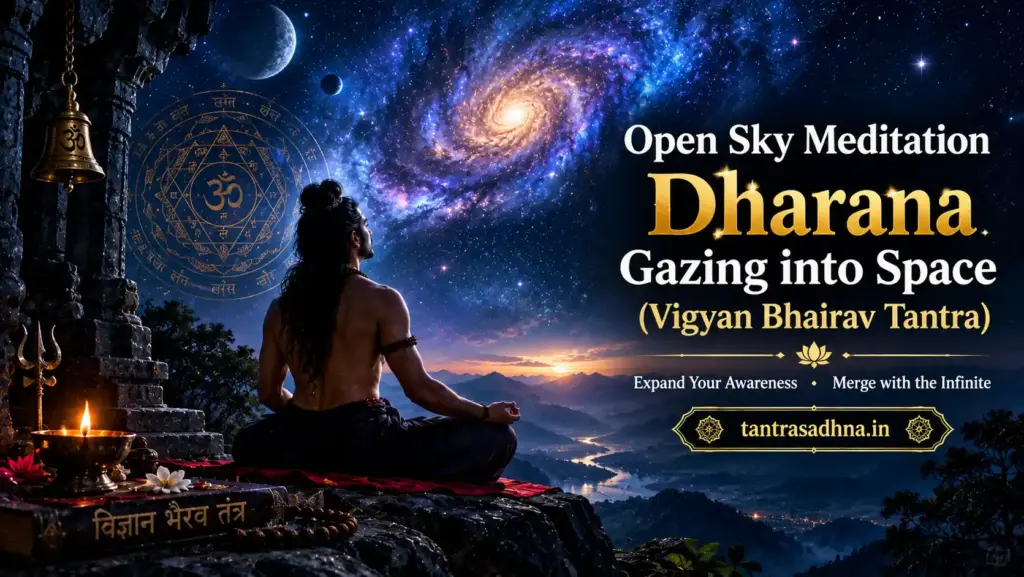
Open Sky Meditation Dharana – Gazing into Space (Vigyan Bhairav Tantra)
Of all the objects that the 112 dharanas of Vigyan Bhairav Tantra use as doorways into awareness, few are as immediately available or as strikingly simple as the open sky. The sky requires no preparation, no equipment, and no particular setting. It is simply there — vast, unbounded, and transparent. These three qualities are exactly what the dharana works with.
The instruction, at its core, is to gaze softly into open sky and allow awareness to take on the same qualities that the sky has: spacious, unobstructed, without edges or contents. The practice sounds easy. What makes it demanding — and rewarding — is the specific quality of attention it requires.
The Tantric Understanding of Akasha
In the classical Indian framework that underlies the Vigyan Bhairav Tantra, the universe is composed of five elements (pancha mahabhuta): earth, water, fire, air, and space. These are not elements in the modern chemical sense — they are qualities of experience, arranged from the grossest and most contracted to the most subtle and expansive.
Space — akasha in Sanskrit — is the subtlest of the five. It is the element that pervades and contains the other four. Everything that exists, the tradition suggests, exists within space; space itself is not contained by anything. For this reason, the Kashmir Shaiva tradition regards akasha as the element most transparent to consciousness — the least obstructed, the most available, the closest analog in the phenomenal world to the nature of awareness itself.
This is the philosophical basis for the open sky dharana. By resting awareness in open space — by allowing attention to expand into the same quality that space has — the practice is said to bring awareness into contact with its own nature, which the tradition understands to be unbounded and content-free in the same way that the sky is.
Whether this framework is accepted or not, the phenomenological starting point is available to any practitioner: the sky is there, it is open, and directing attention into it with the right quality produces a recognizable, describable quality of inner spaciousness. The philosophical interpretation of that experience is secondary to the experience itself.
The Practice in Detail
Setting up. Go outdoors when a clear sky is available. Overcast skies can work but are less effective in early practice because the visual texture of clouds gives attention something to grip. A clear blue sky — or the open sky at dusk before stars appear — is ideal. Sit or stand in a position where you can look upward without straining the neck. Tilting the head back significantly creates physical tension that interferes with the sitting; a position where the sky is visible at a moderate upward angle, or lying on your back and looking directly upward, both work well.
The quality of gaze. This is where the practice distinguishes itself from simply looking at the sky.
Do not look at the sky as if examining an object. Do not look for something in the sky — a cloud shape, a bird, an edge of color. The quality of gaze this dharana requires is unfocused, soft, and open. Allow the visual field to expand outward into peripheral vision rather than narrowing into a focal point. Let the gaze be receptive rather than directional — as if the sky were looking through you rather than you looking at it.
Practitioners sometimes describe this as the difference between looking and “resting in.” You are not examining the sky. You are inhabiting the same quality it has.
The peripheral expansion. One reliable indicator that the quality of gaze is right is a natural widening of peripheral vision. When gaze is soft and unfocused, the peripheral field tends to open. You become aware of things at the edges of vision without actively looking at them. This peripheral expansiveness mirrors — and the practice suggests, participates in — the quality of unbounded space that is the object of the dharana.
Duration. Twenty to thirty minutes is appropriate for this practice. In early sessions, the quality of spacious attention may appear and disappear several times — arriving briefly, then contracting as ordinary focal attention reasserts itself, then opening again. This coming and going is normal. The practice is in the returning each time, not in maintaining an unbroken state.
Practical Variants
The open sky dharana can be adapted for situations where outdoor practice is not possible.
A large open room. Sit in a large, sparsely furnished room and gaze toward the ceiling or across the expanse of the space. A room provides less of the quality of boundlessness that the sky offers, but a spacious interior can approximate the practice adequately.
Eyes closed, imagining open space. For practitioners who have established a feel for the open quality through outdoor practice, it is possible to reproduce a similar quality of attention inward with eyes closed by imagining or sensing open space expanding in all directions. This variant bridges the open sky dharana with the interior space-awareness practices. It is generally more effective after some outdoor practice has established what the quality of open attention feels like.
The sky at dusk or dawn. Practitioners traditionally report that the sky at dusk — when the light is diffuse and the sky has a deep, even quality without the harshness of midday sun — is particularly well suited to this practice. The quality of the light at these times seems to invite the unfocused gaze more naturally than direct bright daylight.
What Practitioners Report
Those who practice this dharana consistently report a distinctive quality of inner expansion — a sense that awareness becomes less contracted, less defined by edges and boundaries. This is commonly described not as a dramatic altered state but as a quality of settledness combined with spaciousness: the ordinary feeling of being confined to a particular location in a particular body relaxes, and the background space of experience becomes more prominent.
Practitioners also typically report that this quality tends to carry beyond the sitting. The sense of spacious awareness developed during the sky-gazing session is described as lingering into ordinary activity — a background quality that makes daily experience feel less pressured and constricted.
These are honest descriptions of practitioner experience. They are not guaranteed outcomes, and they vary considerably between individuals and across sessions. The practice is what produces the conditions for these qualities; the qualities themselves arrive on their own terms.
Caution Regarding Forced Expansion
The most common error in this practice is attempting to produce the feeling of expansion through effort. Concentrating harder, straining the gaze, actively trying to “make” awareness expand — all of these contract rather than open the quality of attention. The dharana asks for a relaxed, receptive, spacious gaze, and it is this relaxation that allows the opening to occur naturally.
If you find yourself straining or efforting, ease the gaze significantly. Let the eyes become almost unfocused. Let the sky be there without any particular response on your part. The practice is more receptive than it is active.
Similarly, do not attempt to maintain the expansive quality when it begins to contract. Simply return to the soft gaze and allow the quality to re-emerge in its own time.
Relation to Other Dharanas
The open sky dharana and the darkness meditation dharana are natural complements — one works with open, light-suffused space, the other with bounded, dark interior space. Many practitioners find that working with both across separate sessions illuminates different aspects of the same underlying capacity for spacious awareness. Some alternate between the two according to availability and temperament on a given day.
For full context on the 112 techniques and where this dharana fits within the larger map, see the complete dharana guide. To determine whether this technique suits your temperament compared to other approaches, see choose your meditation technique. For guidance on structuring regular practice, see how to practice Vigyan Bhairav Tantra.
Frequently Asked Questions
Do I need a completely clear, sunny sky? A clear sky is ideal, particularly in early practice. Overcast skies can work — some practitioners find the even, diffuse light of an overcast sky conducive to soft gaze. Direct bright sun should be avoided; looking toward bright sunlight causes glare, squinting, and eye strain. Practice during diffuse light conditions: overcast days, dusk, dawn, or shade.
What if I get distracted by clouds, birds, or passing objects? Let them pass through the field of awareness without following them. The quality of attention in this practice is like the sky itself: clouds pass through it, but the sky does not become the clouds. Return to the open, unfocused quality of gaze when attention has been pulled to specific objects.
Can this practice be done with eyes closed? Yes, as a variant once the quality of open attention has been established through outdoor practice. Closing the eyes and sensing or imagining open space in all directions can reproduce a related quality. See the variants section above for more detail.
Is this related to trataka or fixed-gaze practices? The gaze quality is essentially opposite to trataka. Trataka requires a fixed, unwavering focus on a specific point or object. The sky dharana requires a diffuse, soft, unfocused gaze. Both are legitimate techniques, but they train different qualities of attention and should not be conflated.
How long before the quality of spaciousness described by practitioners becomes perceptible? This varies. Some practitioners report a recognizable quality of interior expansion in their first few sessions. For others it develops gradually across several weeks of consistent practice. A minimum of forty days of regular practice is a reasonable period before drawing conclusions.
How is this different from simply relaxing outside? Relaxing outside is pleasant but involves no particular quality of attention. The dharana involves a specific, intentional quality of gaze and a deliberate orientation of awareness toward the spatial quality of the sky. The relaxation produced by the dharana has a different character than ordinary rest — it tends to be accompanied by clarity and a sense of expanded presence rather than simply tiredness or distraction.